 Solar PV & Energy
Hybrid Solar with Battery Storage
Hybrid inverter and LiFePO4 battery to keep power on through outages and evening brownouts, and to store daytime solar for the evening.
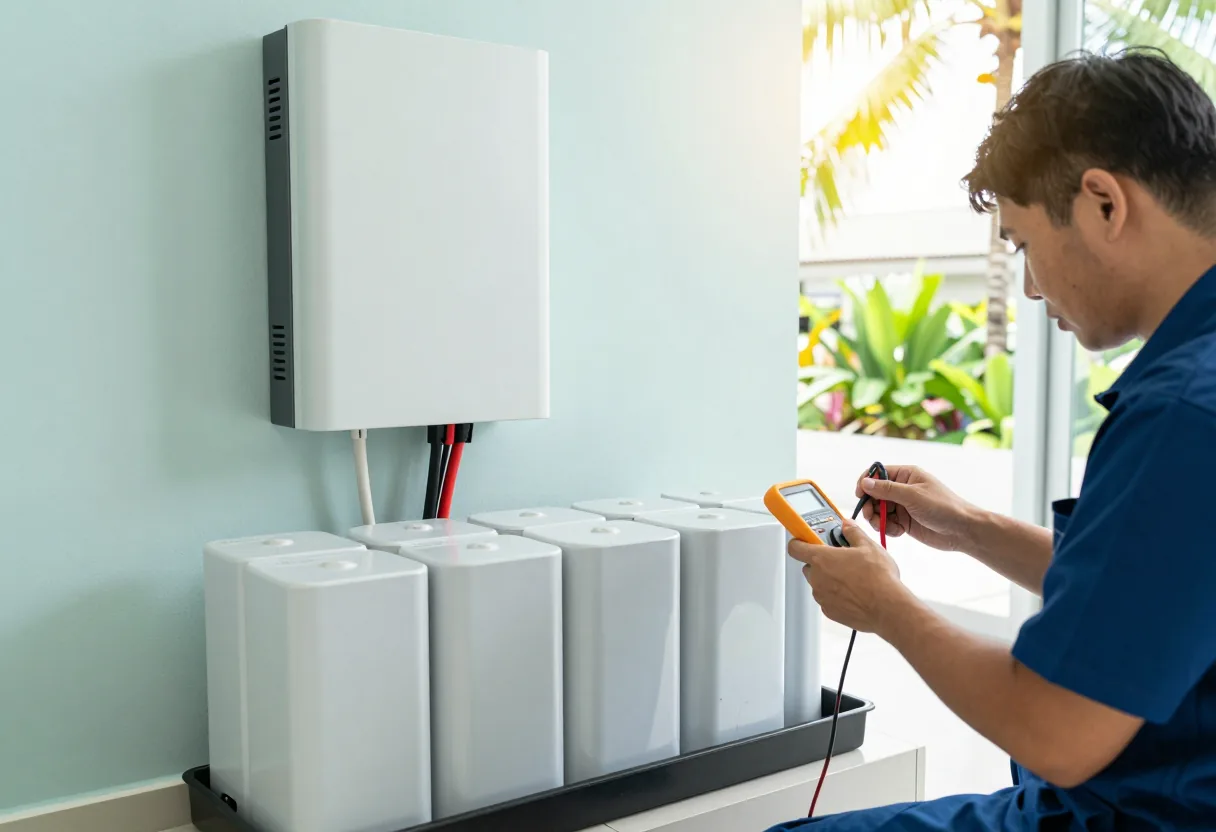
What we usually find on site
In many towns the power dips or cuts out between 17:00 and 20:00 when every house switches on its air conditioning, and in the rainy season falling trees take lines down. Fridges, the shop's point-of-sale, Wi-Fi and CCTV all go dark. A generator is noisy and needs someone to start it. A plain on-grid solar system does not help either, because it shuts down when the grid does.
How hybrid differs from on-grid
A hybrid inverter connects to panels, a battery and the grid at the same time, and has a separate backup (EPS) output for essential loads. When the grid fails, it disconnects from the grid and keeps that output running from the battery and panels. Many models switch over in roughly 10–20 ms, so computers stay on. Some are slower, so if you have sensitive equipment we check the datasheet before we quote.
Choose the essential loads first, then the battery
The mistake we see most is putting the whole house or office on the backup side. Three air conditioners and a water pump will empty a battery in a couple of hours. We split out an essential-loads board: lighting, fridges, router, CCTV, computers and perhaps one air conditioner.
A simple way to think about it: 1.5 kW of essential load for 4 hours is 6 kWh. LiFePO4 lets you use about 90% of its capacity and you want some margin for cloudy days, so choose roughly 8–10 kWh. To run through the night or ride out multi-day outages you need more battery and more panels, or a generator wired into an inverter that supports one.
Why LiFePO4
| LiFePO4 | Lead-acid | |
|---|---|---|
| Usable share of capacity | About 90% | About 50% if you want it to last |
| Cycle life | Several thousand cycles | A few hundred to just over a thousand |
| Heat | Tolerates it better, still wants a cool spot | Life drops fast in a hot room |
| BMS talks to the inverter | Yes (CAN/RS485) | No |
What matters most is that the battery and inverter appear on each other's compatibility list, so the BMS can talk to the inverter and the warranty stays valid.
Read the battery warranty properly
Most LiFePO4 warranties have three limits: years, cycles or total energy throughput (MWh), and a minimum remaining capacity at the end. Whichever is reached first ends the warranty. We explain the terms for the model we propose, in writing.
Tell us what must stay on during an outage and for how long, and we will size the battery and panels. For server rooms, read UPS and power protection alongside this page.
What it does
Essential-loads board
Circuits that must stay on are split from heavy loads so the battery lasts.
LiFePO4 with BMS
48 V or high-voltage batteries that talk to the inverter, with room to add modules later.
Rides through evening brownouts
When grid voltage leaves the safe window the inverter moves to battery, so air conditioners and fridges are not run on low voltage.
Generator input
Some inverters have a generator port for multi-day outages or cloudy rainy-season weeks.
Operating modes set for you
Keep the battery for backup, or use it in the evening while holding a reserve for outages.
A proper battery location
Shaded, ventilated, out of the sun and away from flammables. Heat shortens battery life.
Design and rollout
- 1
Agree which loads must run in an outage, for how long, and how often outages happen in your area.
- 2
Measure essential loads and size battery kWh, inverter kW and array kWp.
- 3
Pick a battery and inverter that are on the makers' compatibility lists.
- 4
Install and split the essential-loads board, battery fusing and breaker, SPDs and earthing.
- 5
Test by actually cutting the grid supply and timing the switchover.
- 6
Set up monitoring and battery alarms, and explain the operating modes.
Where it fits
- Shops and restaurants keeping point-of-sale, chillers and Wi-Fi on during evening outages.
- Health centres and clinics with medicine and vaccine fridges.
- Provincial hotels and guesthouses keeping corridor lights, water pumps and booking systems running.
- Offices with a small server, CCTV and accounting systems.
- Homes with frequent rainy-season outages.
Typical system sizes
Home & Shop
Fits: Essential load up to about 3 kW, outages of a few hours
- Single-phase hybrid inverter, about 5–8 kW
- 48 V LiFePO4 battery, about 5–15 kWh
- Essential-loads board and monitoring app
Office & Clinic
Fits: Three-phase supply, essential load about 5–15 kW
- Three-phase hybrid inverter with high-voltage battery
- Live outage test with switchover timing
- Integration with the existing server UPS
Building & Hotel
Fits: Essential load above 15 kW, or several buildings
- Paralleled hybrid inverters or a building-scale battery system
- Generator and ATS integration
- O&M plan with yearly battery checks
Brands we supply & install










All brand names and trademarks belong to their respective owners. Mention does not imply official partnership unless explicitly stated. Products are sourced through legitimate distribution channels.
FAQ
How long does a LiFePO4 battery last?
A good battery handles several thousand cycles, and most makers warrant around 10 years with a cycle or MWh limit. Real life depends on heat and use: a battery kept somewhere cool and not drained flat every night lasts longer.
Can a hybrid system replace a UPS?
For lights, fridges and ordinary computers, usually yes. For servers and equipment that must see zero transfer time, we still recommend an online UPS in front of them, with the hybrid system extending the backup time.
We already have on-grid solar. Can we add a battery?
Two ways. If the existing inverter is battery-ready, we add a compatible battery. If not, we install a separate battery inverter alongside it (AC-coupled). We check the model and firmware before quoting.
Is a lithium battery safe inside the house?
LiFePO4 has a lower fire risk than other lithium chemistries, but it still has to be installed right: correctly rated DC fuses and breakers, cable of the right size, terminals torqued to spec, and a cool, ventilated spot. Loose terminals are the most common cause of overheating we find.
Related guides
LiFePO4 Batteries for Solar: DoD, Cycles, BMS, Heat and Sizing
Why LiFePO4 has replaced most lead-acid in solar systems, how to read DoD, cycle ratings and warranties, what the BMS does, why heat matters in Laos, and how to size a…
On-Grid, Hybrid or Off-Grid Solar: Which System Fits Your Site?
How the three solar system types behave when the grid fails, what each needs on site, and how to choose for an office, factory, school or remote camp in Laos.
Solar Inverter Types: String, Hybrid, Micro, C&I and Off-Grid Compared
How each inverter type works and where it fits, how to set the DC/AC ratio and match strings, and what to watch in the monitoring app so problems are caught early.
Sizing a UPS Properly: VA, Watts, Power Factor and Real Battery Runtime
Why some 3 kVA UPS units only deliver 1,800 W, how to choose between offline, line-interactive and online, how to estimate runtime realistically, and how to pair a UPS…
How to Choose a Solar Installer: The Buyer's Checklist
What should be in the quote and in the work itself: site survey, a bill of materials with brand and model, string design, commissioning tests, handover documents…
Solar for Schools and Public Buildings: Design, Safety and Upkeep
Schools and offices use power in daylight, which is when solar produces. How to size from the load, choose zero-export on-grid, hybrid or off-grid for remote schools…
Related solutions
Solar PV & Energy
 On-grid Rooftop SolarRooftop solar for homes, shops, offices and schools, sized to your daytime load, with a zero-export option.
 Commercial & Industrial SolarEngineered solar for factory roofs, carports and ground mounts, from a few hundred kWp up to megawatt scale.
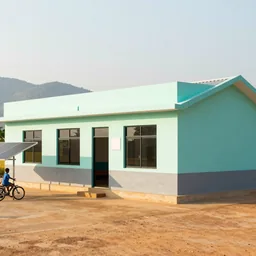 Off-grid Solar for Remote SitesStand-alone power for schools, health posts, farms, work camps and telecom sites with no grid or a weak one.
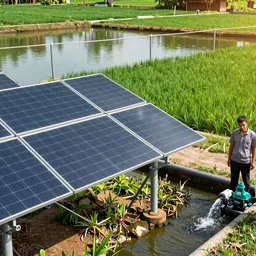 Solar Water PumpingPump from boreholes, streams or ponds with sunlight for orchards, rice fields, farms and village water supply, without fuel or a…
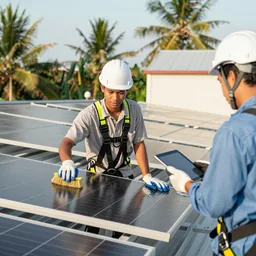 Solar O&M and MonitoringCleaning, inspection, thermal scans, string tests and performance tracking, for systems we installed and systems others installed.
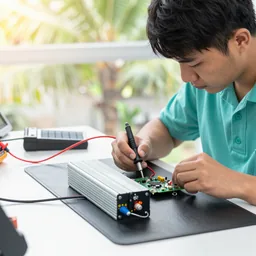 Solar Inverter & System RepairFault-code diagnosis, board-level repair where feasible, warranty claims with the maker, or replacement. Any system, whoever…
Send us a floor plan or a few photos of the site
We’ll come back with a few questions, then a first design. The first consultation is free, in Lao, Thai or English, on WhatsApp or our Facebook page.