 Solar PV & Energy
Solar Inverter & System Repair
Fault-code diagnosis, board-level repair where feasible, warranty claims with the maker, or replacement. Any system, whoever installed it.
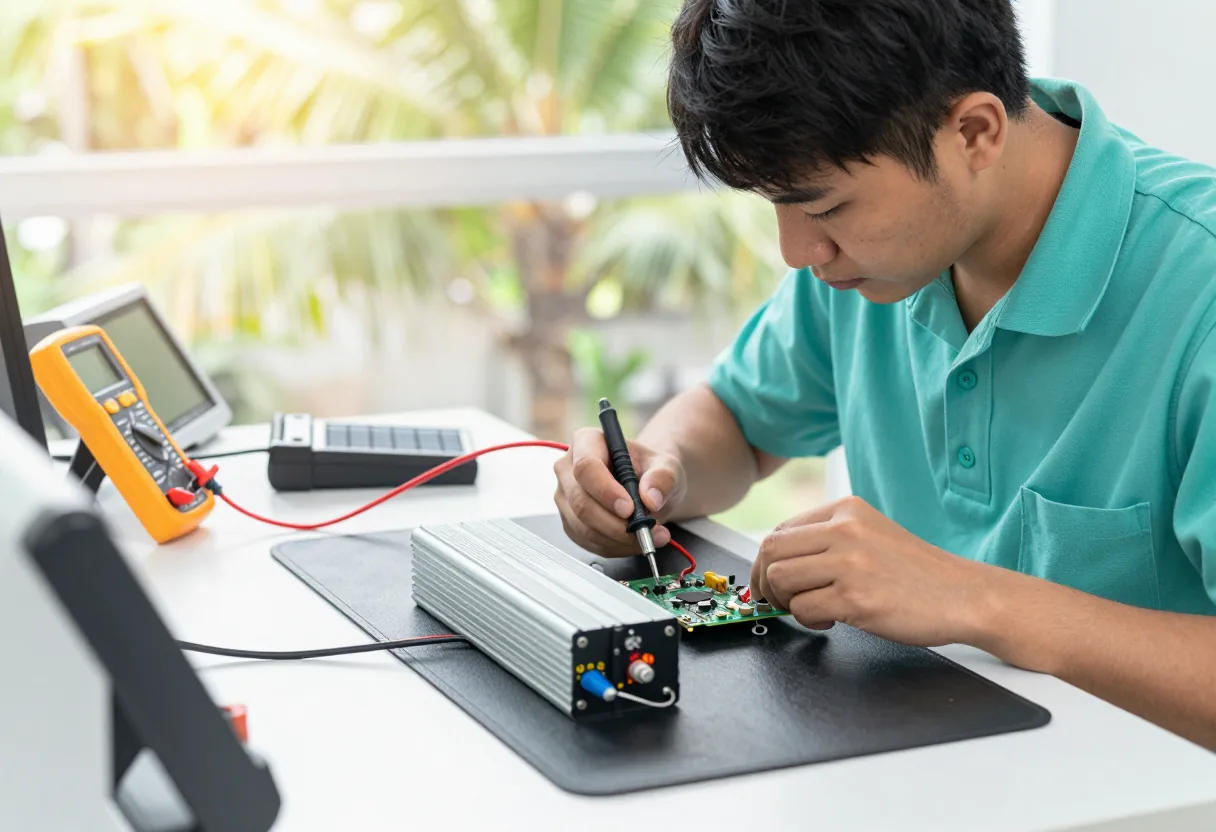
What we usually find on site
The inverter is the part of a solar system that fails most often, especially in hot, dusty places. When the screen shows a fault code, most owners cannot tell whether the inverter has actually failed or the problem is in the cabling, the panels or the grid. The original installer may no longer answer, and nobody knows how to start a warranty return to the maker through Thailand.
Diagnose first, then repair
Many fault codes do not mean the inverter is broken. The inverter is telling you it has detected a problem somewhere else and has disconnected for safety. Replacing an inverter without finding the cause often ends with a new inverter showing the old code.
| Fault family | Common causes | How we check |
|---|---|---|
| Isolation / ISO / low Riso | Water in MC4 connectors, cables chewed or chafed on rails, failed junction box | Insulation test string by string, then trace the point |
| Residual current / GFCI | Leakage to earth, moisture, failed panel | Insulation and leakage tests, including early morning with dew |
| Grid over/under voltage, frequency | High grid voltage at midday, undersized AC cable, wrong settings | Measure voltage at the inverter terminals and at the meter, check settings |
| DC over-voltage | Too many panels in series, cold-morning Voc above the limit | Re-check the string design |
| Over-temperature / fan | Failed fan, dust build-up, mounted in full sun | Check fans, clean, relocate |
| Dead unit, relay or internal faults | Internal power supply, relays, fuses, board components | Measure and inspect at board level |
| Meter / BMS / communication | CT fitted backwards, wrong RS485 wiring, incompatible battery | Check wiring, CT direction and firmware |
Repair, claim or replace
After diagnosis we tell you plainly which route it is and why:
- Board-level repair where parts are available and the design allows it: fans, relays, fuses, capacitors, internal power supplies, communication boards. Some models use sealed boards or locked firmware, and then we tell you it cannot be repaired.
- Warranty claim with the maker if the unit is still covered. We do not open units under warranty, because that would void it. We prepare the case: serial number, fault log, photos and measurements, and coordinate the return through the maker's service channel in Thailand. Claims take weeks, and we give you a realistic timeline.
- Replacement when repair is not possible or not worth it. The new inverter must match the existing strings: MPPT range, maximum DC voltage and current per MPPT. After replacement we re-test and re-configure everything.
Not only inverters
We repair the whole system: burned MC4 connectors replaced with matched pairs of one make, broken panels swapped, earthing and SPDs fixed, zero-export that never worked made to work, and batteries and BMS on hybrid systems checked.
Send us a photo of the fault code, the label on the side of the inverter (model and serial) and a photo of the array on WhatsApp. Often we can point you in the right direction before a site visit.
What it does
Fault-code diagnosis
Fault logs plus on-site measurement to separate inverter, DC-side and grid problems.
Isolation-fault tracing
Insulation tests string by string and panel by panel until the wet connector or cable is found.
Board-level repair
Fans, relays, fuses, capacitors and internal power supplies when parts and design allow.
Maker warranty claims
Case files prepared and the return coordinated through Thailand, without opening units under warranty.
Like-for-like replacement
New inverters chosen to fit the existing strings' MPPT and DC voltage, then re-commissioned.
Any brand, any installer
Systems installed by others, including ones the original installer no longer services.
Design and rollout
- 1
Intake on WhatsApp: fault-code photo, model and serial label, alarm log from the app.
- 2
First remote diagnosis and a warranty-status check.
- 3
On-site checks with insulation tester, clamp meter and multimeter to separate DC, AC and inverter faults.
- 4
Written recommendation: repair, warranty claim or replacement, with the reasons.
- 5
Repair or install, then test strings, insulation and settings as for a new system.
- 6
Repair report, then production watched for the next 2–4 weeks.
Where it fits
- Inverters that show an isolation fault every rainy-season morning and clear by noon.
- Rooftop systems that trip at midday on high grid voltage.
- Hybrid inverters that stopped talking to the battery after a battery swap.
- Inverters that went dead after a nearby lightning strike.
- Systems where zero-export never worked because the CT was fitted backwards.
Typical system sizes
Diagnosis
Fits: Any brand and size, before you decide to repair or replace
- Remote diagnosis from photos and alarm logs
- On-site DC and AC measurements
- Written cause and options
Repair or Claim
Fits: Units that can be repaired or are still under warranty
- Board-level repair where feasible
- Claim file and coordination with the maker
- Removal, refit and re-test
Replace & Upgrade
Fits: Units beyond repair, or systems adding a battery
- Inverter selected to fit the existing strings
- Hybrid option for adding storage
- Full re-commissioning and new monitoring set-up
Brands we supply & install







All brand names and trademarks belong to their respective owners. Mention does not imply official partnership unless explicitly stated. Products are sourced through legitimate distribution channels.
FAQ
Which inverter brands can you repair?
We can diagnose any brand, since the measurements are the same. Whether board-level repair is possible depends on the model and parts availability. We tell you after diagnosis; we do not promise in advance.
The unit is under warranty but the installer will not answer. What now?
A maker's warranty is usually tied to the serial number, not the installer. We diagnose, gather the evidence and help file the claim with the maker. A purchase receipt or installation date makes it easier, so keep them if you have them.
Can the system run while we wait for a repair?
The building keeps running on grid power as normal. With several inverters, the others keep producing. For off-grid systems and critical sites we look for a temporary fix first where possible.
Why does the isolation fault only appear in the morning?
Dew and moisture get into a connector or a cable with cracked insulation and pull the insulation resistance down. Once the sun dries it out, the reading recovers. Treat it as a warning, not a nuisance: that point will get worse and can overheat.
Related guides
Solar Inverter Fault Codes: What the Owner Can Check and What Needs a Technician
The fault families every inverter brand shares: low insulation resistance, ground fault, grid voltage or frequency out of range, overtemperature, reverse polarity, arc…
Solar Inverter Types: String, Hybrid, Micro, C&I and Off-Grid Compared
How each inverter type works and where it fits, how to set the DC/AC ratio and match strings, and what to watch in the monitoring app so problems are caught early.
Solar O&M and Cleaning Checklist: Dust Season, Safe Cleaning and the Numbers to Watch
A cleaning schedule built around Lao seasons including the burning season, how to clean without damaging panels or people, monthly, quarterly and annual checklists…
Related solutions
Solar PV & Energy
 On-grid Rooftop SolarRooftop solar for homes, shops, offices and schools, sized to your daytime load, with a zero-export option.
 Commercial & Industrial SolarEngineered solar for factory roofs, carports and ground mounts, from a few hundred kWp up to megawatt scale.
 Hybrid Solar with Battery StorageHybrid inverter and LiFePO4 battery to keep power on through outages and evening brownouts, and to store daytime solar for the…
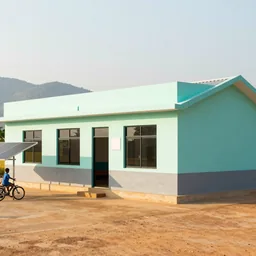 Off-grid Solar for Remote SitesStand-alone power for schools, health posts, farms, work camps and telecom sites with no grid or a weak one.
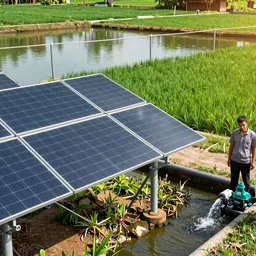 Solar Water PumpingPump from boreholes, streams or ponds with sunlight for orchards, rice fields, farms and village water supply, without fuel or a…
 Solar O&M and MonitoringCleaning, inspection, thermal scans, string tests and performance tracking, for systems we installed and systems others installed.
Send us a floor plan or a few photos of the site
We’ll come back with a few questions, then a first design. The first consultation is free, in Lao, Thai or English, on WhatsApp or our Facebook page.