Trina Solar
Trina Solar (Trinasolar) is headquartered in Changzhou, China. Its Vertex N line uses i-TOPCon cells for projects and factory roofs, while Vertex S+ is a smaller glass-glass module for homes and commercial buildings. The company also makes utility-scale storage (Elementa) and solar trackers.
- Headquarters
- China
- Positioning
- Mid-marketEnterprise
- Official website
- www.trinasolar.com

Who it suits
Homes and shops that want a glass-glass module in a size that is easy to lift onto a roof, from a large maker.
Overview
Who Trina Solar is
Trina Solar (now styled Trinasolar) is headquartered in Changzhou, Jiangsu, China. In 2025 it remained one of the largest module shippers in the world. Besides modules it makes utility-scale storage (Elementa) and solar trackers, but those are for power-plant projects, not building roofs.
The two module lines to know
- Vertex N: N-type modules built on Trina's own i-TOPCon cells and the large 210 mm cell format. The Vertex N G3, launched in 2026, uses i-TOPCon Ultra cells and reaches about 760 W and up to 24.5% efficiency, glass-glass, with bifaciality of about 85% (±5%). It is built for ground mounts and large factory roofs.
- Vertex S+: a smaller module (about 1762 × 1134 mm in the G3 version), glass-glass, for homes and commercial buildings. The monofacial Vertex S+ G3 reaches about 485 W.
Warranty and the numbers that matter
For Vertex N G3, Trina gives a 12-year product warranty and a 30-year power warranty. Remember the difference: the product warranty covers a module that fails; the power warranty covers output that falls below the stated line after the allowed yearly degradation.
Read three numbers on the datasheet of the exact model being quoted: the Pmax temperature coefficient (closer to zero is better in hot climates), first-year and annual degradation, and short-circuit current (Isc). The last one matters for 210 mm-cell modules: their current is higher than typical modules, so check that the inverter's MPPT inputs can take it. Many older inverters cannot.
Who it suits
Vertex S+ suits house, shop and office roofs that want a glass-glass module two people can lift easily. Vertex N suits projects of several hundred kWp and up, where the inverter is chosen to match the module current from the start.
Strengths
- Vertex S+ is a small glass-glass module, which not every large maker offers. It handles humidity better than backsheet modules and is easy to lift onto a house roof.
- Vertex N G3 delivers high power per module, so large projects need fewer modules, less racking and less cabling per kWp.
- A large maker that has been on Tier 1 lists for a long time and makes its own cells, which makes a long warranty more credible.
- The glass-glass build of Vertex N G3 is designed to resist salt, ammonia, sand, heat and humidity, which suits livestock-farm and factory roofs.
Things to know before choosing
- 210 mm-cell modules carry high current. On an inverter whose MPPT cannot take it you lose energy every day or breach the inverter warranty terms. Always check module Isc against the inverter datasheet.
- Vertex N modules of 700 W and above are large and heavy, and do not suit house roofs or roofs with difficult access.
- Which models are in Thai stock changes over time. The new G3 versions may need to be ordered ahead; ask about lead time before locking the design.
- Warranty terms differ by model and market. Ask for the warranty document of the exact model you buy, not the figure from an advert.
Using it in Laos
Notes for Laos:
- Livestock farms and factories: chicken and pig farm roofs carry ammonia and high humidity. Glass-glass modules suit them better than backsheet modules, but the racking and bolts must also be stainless steel or corrosion-resistant aluminium.
- Dust: the dry season is dusty and the first rains often leave muddy streaks rather than cleaning. Wash modules before the hot season (March–April), when sunshine is strongest.
- Inverter choice: for Vertex N we pick inverters whose MPPT inputs take high current, and we check string voltage on the coldest morning (January) so it never exceeds the inverter limit.
- Supply and claims: order through Thai distributors. Keep serial numbers and handover test results as evidence.
A fit for homes, shops and offices (Vertex S+) and for factories, farms and ground mounts (Vertex N). See on-grid rooftop solar.
Compared with alternatives
JinkoSolar Tiger Neo 3.0 and JA Solar DeepBlue 5.0 offer 2382 × 1134 mm TOPCon modules with lower current than 210 mm modules, so they match common inverters more easily; pick them when you are reusing older inverters. LONGi fits better when roof area is tight. Choose Trina for a small glass-glass module (Vertex S+) or the highest power per module on large projects.
Product lines
- Vertex N
- Vertex S+
Solutions that use this brand
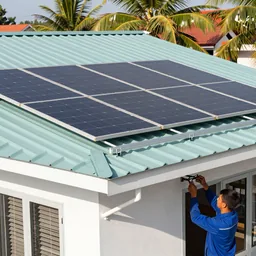 On-grid Rooftop SolarRooftop solar for homes, shops, offices and schools, sized to your daytime load, with a zero-export option.
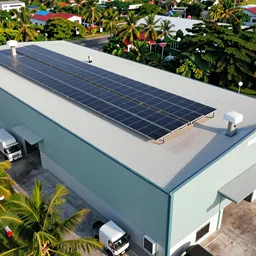 Commercial & Industrial SolarEngineered solar for factory roofs, carports and ground mounts, from a few hundred kWp up to megawatt scale.
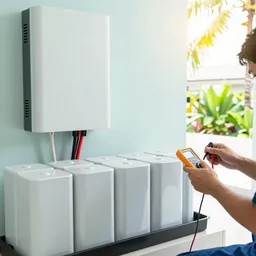 Hybrid Solar with Battery StorageHybrid inverter and LiFePO4 battery to keep power on through outages and evening brownouts, and to store daytime solar for the…
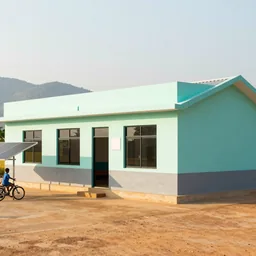 Off-grid Solar for Remote SitesStand-alone power for schools, health posts, farms, work camps and telecom sites with no grid or a weak one.
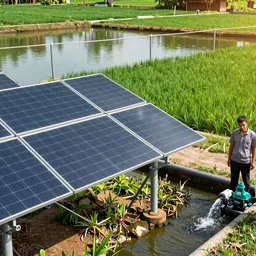 Solar Water PumpingPump from boreholes, streams or ponds with sunlight for orchards, rice fields, farms and village water supply, without fuel or a…
FAQ
Is a 760 W module always better than a 600 W one?
Not always. Higher wattage mostly comes from a bigger module, not just better efficiency. Compare efficiency (%), the temperature coefficient, and whether the module fits your roof structure and inverter.
Does Trina have a home battery?
Trina's Elementa storage is for utility-scale projects. For homes and offices we pair Trina modules with LiFePO4 batteries such as BYD or Pylontech and a hybrid inverter that supports that battery.
How do glass-glass modules differ from backsheet modules in the Lao climate?
A backsheet module has a plastic rear sheet that can crack or let moisture in after years of heat and humidity. A glass-glass module seals the cells between two panes, so it resists moisture and degradation better, but it is slightly heavier and must be clamped where the maker specifies.
All brand names and trademarks belong to their respective owners. Mention does not imply official partnership unless explicitly stated. Products are sourced through legitimate distribution channels.
Send us a floor plan or a few photos of the site
We’ll come back with a few questions, then a first design. The first consultation is free, in Lao, Thai or English, on WhatsApp or our Facebook page.