JinkoSolar
JinkoSolar is headquartered in Shanghai, China, and was among the largest module shippers in the world in 2025. Its main line is Tiger Neo, built on N-type TOPCon cells; the current Tiger Neo 3.0 comes in large formats for projects and smaller formats for rooftops.
- Headquarters
- China
- Positioning
- Mid-marketEnterprise
- Official website
- www.jinkosolar.com

Who it suits
Factory roofs, carports and ground mounts that want bifacial TOPCon modules that are easy to source in Thailand.
Overview
JinkoSolar in 2026
JinkoSolar is headquartered in Shanghai, China, and marks 20 years in 2026. In 2025 it was one of the two largest module shippers in the world, and it did more than most to make N-type TOPCon the market standard. It also has an energy-storage business, but what customers in Laos actually meet is its modules.
What Tiger Neo 3.0 includes
Tiger Neo 3.0 is Jinko's third-generation TOPCon. There are two main groups:
- Large 66-row modules (2382 × 1134 mm): up to about 670 W and 24.8% efficiency, for ground mounts, carports and factory roofs.
- Smaller 48-row modules (1762 × 1134 mm): about 485–495 W, for house and commercial roofs where modules are carried up by hand.
All are glass-glass. Bifacial versions have a bifaciality of about 85% (±5%), meaning the rear produces about 85% of what the front would under equal light. In practice the rear gets far less light, so the gain depends on the surface underneath: grass or soil adds little, white gravel or a white roof adds more. In some markets Jinko also offers anti-dust versions for dusty sites.
Numbers worth reading on the datasheet
- Temperature coefficient −0.26%/°C: with cells at 60°C, output is about 9% below nameplate.
- Degradation: about 1% in year one, then about 0.35–0.4% per year depending on the model. After 30 years a module should still give roughly 87–88% of its original power.
- Warranty: the product warranty (manufacturing defects) and the linear power warranty (30 years on glass-glass modules) are two separate promises. Product-warranty length varies by market and model, so read it from the warranty document that applies in our region, not from another market's website.
Who it suits
Jinko fits projects of every size, from house roofs to multi-MW ground mounts. Its strength for Laos is that it has several distributors in Thailand, so modules are easy to source and reach Vientiane without long waits.
Strengths
- One of the largest module makers and on Tier 1 lists for years, which is what banks and procurement teams usually ask for.
- Large project modules and 48-row rooftop modules in the same family, so documents and warranty terms are consistent across projects.
- Jinko signed distribution agreements with several Thai companies for Tiger Neo 3.0, and the large rooftop system at Bangkok's Krung Thep Aphiwat Central Terminal uses Tiger Neo modules, so replacements are not hard to find.
- Glass-glass construction and a −0.26%/°C temperature coefficient suit the hot, humid Lao climate.
Things to know before choosing
- The product-warranty length you see on Jinko's European or Australian sites may not match modules sold in Thailand. Always ask for the warranty document for the model and market you actually buy.
- The 66-row module is 2.38 m long and heavy; it does not suit light house roofs or roofs with difficult access. Use the 48-row version there.
- The rear-side gain of bifacial modules is often oversold. On a metal roof with modules mounted low the gain is small; never size a system from the brochure's best-case figure.
- Special versions such as anti-dust or all-black may not always be in Thai stock. Ask about lead time before locking the design.
Using it in Laos
What to know for sites in Laos:
- Dust and bird droppings: in the dry season dust collects along the bottom edge of the module and shades the lowest row of cells. Tilt modules at least 10° so rain can rinse them, and clean more often near mines or dirt roads.
- The surface under bifacial modules: on ground mounts and carports, raise modules well above the ground and keep the surface clean if you want any rear-side gain.
- Sourcing from Thailand: Jinko is easy to find in Thailand, but check that serial numbers and model codes match the quote, and inspect for breakage on delivery.
- Heat: leave an air gap under the modules. Modules mounted flush to the roof run hotter and produce less.
A good fit for factory and warehouse roofs, schools and solar water pumping on farms. Read more on choosing modules in our Tier 1 panels guide.
Compared with alternatives
JA Solar DeepBlue 5.0 and Trina Solar Vertex N are TOPCon modules in the same class with very similar numbers; the choice usually comes down to which Thai distributor has stock and clear warranty handling. LONGi Hi-MO 9 fits better when roof area is limited or partly shaded, while Jinko fits open sites that benefit from the rear side.
Product lines
- Tiger Neo 3.0
- Tiger Neo
Solutions that use this brand
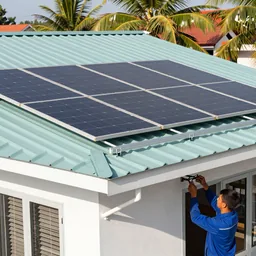 On-grid Rooftop SolarRooftop solar for homes, shops, offices and schools, sized to your daytime load, with a zero-export option.
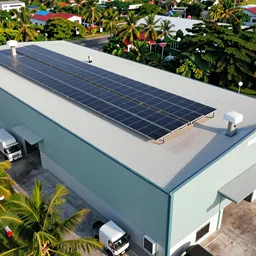 Commercial & Industrial SolarEngineered solar for factory roofs, carports and ground mounts, from a few hundred kWp up to megawatt scale.
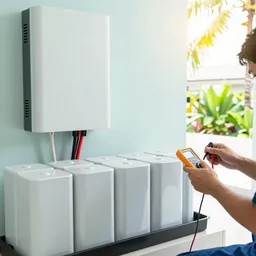 Hybrid Solar with Battery StorageHybrid inverter and LiFePO4 battery to keep power on through outages and evening brownouts, and to store daytime solar for the…
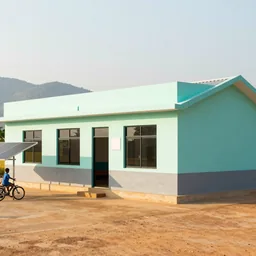 Off-grid Solar for Remote SitesStand-alone power for schools, health posts, farms, work camps and telecom sites with no grid or a weak one.
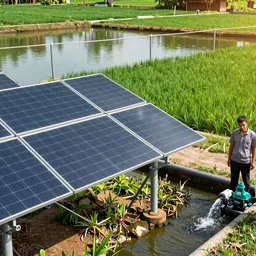 Solar Water PumpingPump from boreholes, streams or ponds with sunlight for orchards, rice fields, farms and village water supply, without fuel or a…
FAQ
How is Tiger Neo 3.0 different from the older Tiger Neo?
Version 3.0 uses a newer TOPCon cell that gives more power and efficiency in the same module size, with higher bifaciality. Older Tiger Neo modules are still good; if you add new modules to an old system, put them on a separate string or MPPT.
Are bifacial modules worth it on a roof?
On a metal roof with low-mounted modules the rear-side gain is small. Jinko's bifacial modules are glass-glass and handle humidity well, though, so we often still use them. We size yield with little or no rear-side gain.
If a Jinko module fails, how do we claim?
We test the module with an IV trace or thermal scan to confirm the fault, then send the evidence with the serial number and invoice to the Thai seller, who passes it to Jinko. If a spare is on hand we swap it first so the system is not down while the claim runs.
All brand names and trademarks belong to their respective owners. Mention does not imply official partnership unless explicitly stated. Products are sourced through legitimate distribution channels.
Send us a floor plan or a few photos of the site
We’ll come back with a few questions, then a first design. The first consultation is free, in Lao, Thai or English, on WhatsApp or our Facebook page.