On this page
- Start with one question: what happens at 17:30 when the power goes out?
- On-grid: daytime power, no backup
- Hybrid: solar plus a battery that keeps key loads alive
- Off-grid: when there is no grid, or the grid cannot be trusted at all
- One more case: water pumping
- Side by side
- Lao conditions that change the answer
- Common mistakes we see
- Can I start on-grid and add a battery later?
- How to decide in five minutes
- How we can help
Start with one question: what happens at 17:30 when the power goes out?
Most people who ask us about solar start with the panels. We start with the power cut. If the grid drops in the evening, do you need the lights, the server, the freezer or the water pump to keep running? Or is the goal simply to use your own electricity during the day while the grid stays as the backbone? The answer decides the system type far more than roof size or budget does.
There are three families: on-grid (also called grid-tied), hybrid with a battery, and off-grid. They share the same panels and much of the same wiring. What changes is the inverter, whether there is a battery, and how the system behaves when the grid is missing.
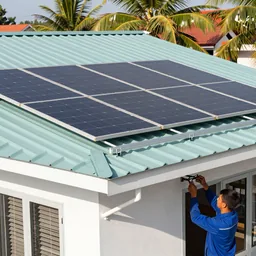
On-grid: daytime power, no backup
An on-grid system turns DC from the panels into AC that runs in parallel with the grid. During the day your loads use solar first, and whatever is missing comes from the grid. If the panels produce more than the building uses, the surplus either flows back to the grid or, with a zero-export setting, the inverter throttles itself so nothing leaves the building.
The point people often miss: an on-grid inverter switches off when the grid fails. This is anti-islanding protection, and it exists so the system cannot energise a line that a lineman believes is dead. A building full of on-grid panels still goes dark in an outage, even at midday.
On-grid suits:
- Offices, schools, shops and factories that use most of their electricity between about 8:00 and 17:00
- Buildings where outages are rare or already covered by a generator or UPS
- Owners who want the simplest, lowest-maintenance option, with no battery to replace
Typical parts: panels, mounting, DC cable and DC isolators, a string inverter (or microinverters), surge protection (SPD) on both the AC and DC side, a meter or smart sensor if you want export limiting, and an online monitoring app.
Hybrid: solar plus a battery that keeps key loads alive
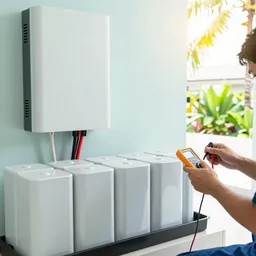
A hybrid inverter does everything an on-grid inverter does and also manages a battery. During the day it feeds the loads, charges the battery and, if allowed, exports. When the grid fails, it disconnects from the grid through an internal or external transfer switch and powers a backup circuit from the battery and panels.
Notice the words "backup circuit". In most installations we do not back up the whole building. We split the distribution board: lighting, computer sockets, network racks, CCTV, the fridge and maybe one or two fans go on the backup side. Air conditioners, water heaters and big motors stay on the grid-only side. A battery that can carry a 1.5 kW essential load for four hours would be flattened in under an hour by three air conditioners.
Switching time matters too. Many hybrid inverters change over in roughly 10–20 milliseconds, and some are faster. Desktop PCs usually ride through this, but servers and network gear are still better behind a small UPS. See our UPS and power protection page for that layer.
Hybrid suits:
- Sites with frequent brownouts, voltage dips or outages during the evening peak
- Offices and clinics that must keep the network, lights and refrigeration running
- Homes and shops that want solar during the day and stored solar after sunset
What changes compared with on-grid: a battery (almost always LiFePO4 today), a ventilated battery cabinet or wall mount, a split distribution board, and more careful commissioning of the communication link (CAN or RS485) between the inverter and the battery's BMS. We explain battery choices in the LiFePO4 battery guide.
Off-grid: when there is no grid, or the grid cannot be trusted at all
An off-grid system has no grid connection. Panels charge a battery, and an off-grid inverter makes the AC the site uses. A generator is often added as a backup charger for long cloudy spells.
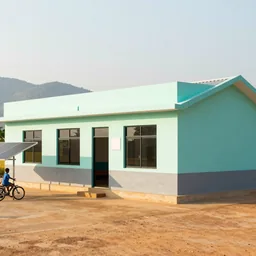
This is the right answer for provincial schools, health posts, farms, telecom shelters, mine and construction camps, and anything far from the last pole. It is also the hardest to design, because the battery and panels must cover every kWh the site uses, including rainy weeks.
Design points that matter for off-grid in Laos:
- Size for the rainy season, not for March. Peak sun hours across Laos and Thailand average about 4.5–5.5 per day, and can fall well below that for days at a time between June and September.
- Plan days of autonomy: how many cloudy days the battery must carry before the generator starts.
- Keep the load list honest. One extra chest freezer can change the system size more than any other decision.
- Remote means hard to service. Choose equipment whose monitoring works over a mobile data link, and where possible keep spare fuses, an MC4 crimp tool and a spare board or charge controller on site.
One more case: water pumping
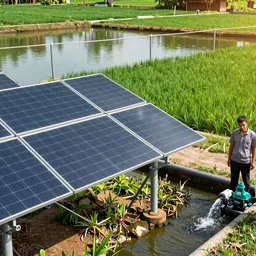
If the goal is to pump water for fields or a village, a solar pump drive can run the pump directly from the panels with no battery. Instead of storing energy in a battery, you store water in a tank. See solar water pumping.
Side by side
| On-grid | Hybrid | Off-grid | |
|---|---|---|---|
| Works during a grid outage | No | Yes, backup circuit only | Yes, whole site |
| Battery | None | Yes | Yes, larger |
| Grid needed | Yes | Yes (can run without it for a while) | No |
| Design difficulty | Low | Medium | High |
| Maintenance | Low | Medium (battery) | Higher (battery, generator, remote) |
| Typical sites | Offices, factories, schools with daytime load | Clinics, offices, homes, shops with brownouts | Remote schools, camps, farms, telecom |
Lao conditions that change the answer
Grid electricity is relatively inexpensive in many parts of Laos, so the case for solar is rarely about the bill alone. What we hear more often is reliability: voltage sagging in the evening peak, short outages during storms in the rainy season, and provincial sites at the end of long, weak lines. That pushes many projects toward hybrid. Heat matters as well. Inverters derate when their heatsinks get hot, so an inverter mounted on a west wall in direct afternoon sun produces less and ages faster. Dust from unpaved roads and construction sites settles on the panels and lowers output until it is washed off. None of this changes which type you pick, but it changes where you mount the inverter, how you ventilate the battery and how often someone cleans the array.
Common mistakes we see
- Buying on-grid and expecting backup. The first outage after installation is a bad day to learn about anti-islanding.
- Backing up the whole board. The battery empties in minutes and the owner thinks it is faulty.
- Sizing off-grid from the dry season. The system works perfectly until July.
- Pairing a hybrid inverter with a battery it cannot talk to. Check the maker's battery compatibility list before buying either one.
- Forgetting the generator. If a site already has a generator, decide early whether the inverter may start it and how the two are interlocked so they never feed each other.
Can I start on-grid and add a battery later?
Usually yes, but plan for it on day one. There are two paths. You can install a hybrid inverter now, run it without a battery and add the battery later. Or you keep the on-grid inverter and add an AC-coupled battery inverter beside it. The first is usually tidier for homes and small offices. The second suits larger buildings where the existing on-grid inverter is working well. Either way, leave wall space, cable routes and a split board ready now.
How to decide in five minutes
- Mostly daytime load and a reasonably stable grid: on-grid, with zero-export if you do not want to export.
- Daytime load plus evening outages you cannot accept: hybrid, with a carefully chosen backup circuit.
- No grid, or a grid so weak that a generator runs most days: off-grid, sized for the rainy season.
Then move on to sizing. Our solar system sizing guide works through examples in kWh and kWp, and the inverter types guide explains which inverter family fits each choice.
How we can help
Our team has designed and installed more than 5 MW of solar PV in Thailand, covering on-grid, hybrid and off-grid systems. Before recommending a type, we visit the site, read up to 12 months of electricity bills if you have them, and look at when your outages actually happen and which circuits must stay alive. Send us a photo of your main distribution board and a recent bill, and we will tell you which of the three types we would start from and why. You can see everything we do on our solar page, including on-grid rooftop, hybrid with battery and off-grid systems.
- #solar
- #on-grid
- #hybrid
- #off-grid
- #battery
- #backup-power