Pylontech
Pylontech (Pylon Technologies) is headquartered in Shanghai, China, and builds LiFePO4 batteries specifically for energy storage. Its US series (such as US5000 and US3000C) are 48 V rack-mount modules widely used in hybrid and off-grid systems. Force H3 is a stackable high-voltage system, and OPTIM covers commercial and industrial storage.
- Headquarters
- China
- Positioning
- EntryMid-market
- Official website
- en.pylontech.com.cn

Who it suits
48 V hybrid and off-grid systems that need to add batteries one module at a time and work with many inverter brands.
Overview
Who Pylontech is
Pylontech (company name Pylon Technologies) is headquartered in Shanghai, China, and builds LiFePO4 batteries specifically for energy storage, not for vehicles. Its 48 V US series is one of the batteries solar installers meet most often in small and mid-size hybrid and off-grid systems.
Product lines
- US5000 / US3000C (48 V, rack-mount): US5000 holds 4.8 kWh per module (48 V, 100 Ah), allows about 95% depth of discharge and is rated for more than 6,000 cycles on the datasheet. Up to 16 modules can be paralleled in one group. The modules are IP20, so they must sit in a room or cabinet that keeps out dust and water. US3000C is the smaller module.
- Force H3 (high-voltage, stackable): 5.12 kWh modules stacked up to about 35 kWh per tower, IP65 for outdoor installation. It needs a compatible high-voltage hybrid inverter.
- Pelio: a newer battery for homes.
- OPTIM: storage systems for commercial, industrial and larger projects.
Inverter compatibility
The biggest strength of the US series is a BMS that talks over CAN or RS485 to many hybrid inverter brands, such as Deye, Solis and Victron. With BMS communication, the inverter knows the real state of charge and the charge current the battery will accept, so the battery is charged correctly and lasts longer than with voltage-only settings.
Warranty
For US5000, Pylontech offers up to 10 years in total in some markets once the product is registered. The conditions, the guaranteed remaining capacity and the throughput limit vary by region. Temperature is also a condition: the datasheet allows charging at 0–50°C and recommends 10–40°C for best life.
Who it suits
48 V hybrid systems for homes, shops and offices; off-grid systems for schools, health posts, farms and telecom sites; and projects that want to start with a small battery and add modules one at a time.
Strengths
- The BMS talks to many hybrid inverter brands, so if you change the inverter later the battery can usually stay.
- Capacity grows 4.8 kWh at a time, so you can start small within budget and expand as loads grow.
- US-series batteries are stocked by many solar equipment shops in Thailand and many installers know them, so extra or replacement modules are not hard to find.
Things to know before choosing
- New and old modules (different BMS versions) can be combined only under conditions: per the manual, the module with the newest BMS normally has to be the master. Wired wrongly, the system throws errors or never charges fully.
- The US series is IP20. It must be installed in a room or cabinet that keeps out dust, water and insects, especially on farms or mine sites.
- Warranty terms (including registration) differ by region. Ask the Thai seller to confirm in writing who handles claims and how.
- Batteries from online marketplaces or grey imports may have no regional warranty or may be used. Check serial numbers and buy from a seller who issues a tax invoice.
Using it in Laos
What we see in Laos:
- Off-grid in the provinces: schools, health posts and farms with no grid or a weak one usually run 48 V systems. Pylontech US with a hybrid inverter that talks to the BMS is a combination that is easy to repair and find parts for.
- Heat: a battery room built of metal sheet, or a steel cabinet in the sun, easily goes above 40°C. Use a shaded room with vents or a fan, and raise the batteries off the floor in case of flooding.
- Dust and insects: use a cabinet with insect mesh, because ants and cockroaches get into terminals.
- Shipping: lithium batteries are dangerous goods, so allow enough time for import from Thailand.
Read how to size a battery in our LiFePO4 battery guide and see off-grid solar.
Compared with alternatives
BYD Battery-Box fits better when you want a high-voltage battery with an inverter on BYD's list and a single stacked tower. Huawei LUNA2000 fits an all-Huawei system where everything is monitored in the FusionSolar app. Choose Pylontech for 48 V and off-grid systems, and where you want the battery not tied to one inverter brand.
Product lines
- US5000
- US3000C
- Force H3
- Pelio
- OPTIM
Solutions that use this brand
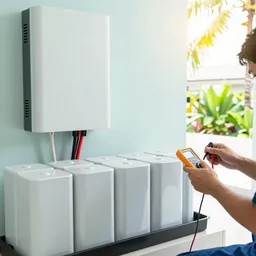 Hybrid Solar with Battery StorageHybrid inverter and LiFePO4 battery to keep power on through outages and evening brownouts, and to store daytime solar for the…
 Off-grid Solar for Remote SitesStand-alone power for schools, health posts, farms, work camps and telecom sites with no grid or a weak one.
 Solar O&M and MonitoringCleaning, inspection, thermal scans, string tests and performance tracking, for systems we installed and systems others installed.
 Solar Inverter & System RepairFault-code diagnosis, board-level repair where feasible, warranty claims with the maker, or replacement. Any system, whoever…
FAQ
How many battery modules do we need?
Work from the energy you need without sun. Example: a 1 kW load for 6 hours = 6 kWh. A US5000 gives about 4.5 kWh usable, so you need 2 modules, and a third is wise for rainy days and ageing. The module count must also cover the current the inverter draws.
Will Pylontech work with an inverter bought online?
If the inverter lists Pylontech among its battery types and the CAN or RS485 cable is wired correctly, it usually works. If the inverter cannot communicate, the battery runs on voltage settings only, which we do not recommend and which may affect the warranty.
The battery shows a red error light. Can it be fixed?
Often the cause is settings, the communication cable, the wrong master module or over-discharge, not a dead battery. We read the BMS and inverter logs first, and if a module really has failed we prepare the claim data. See inverter and system repair.
All brand names and trademarks belong to their respective owners. Mention does not imply official partnership unless explicitly stated. Products are sourced through legitimate distribution channels.
Send us a floor plan or a few photos of the site
We’ll come back with a few questions, then a first design. The first consultation is free, in Lao, Thai or English, on WhatsApp or our Facebook page.