On this page
- Two quotes for the same size can be two different systems
- 1. Did they survey the site properly?
- 2. Is every item named with brand and model?
- 3. Can you check the design?
- 4. How will they actually install it?
- 5. What commissioning tests will you receive?
- 6. What do you get at handover?
- 7. How will warranties be handled?
- 8. What happens after installation?
- 9. Ask about sourcing, lead time and spare parts
- Red flags in one list
- Ten questions to copy into your email
- How we work
Two quotes for the same size can be two different systems
Put two solar quotes side by side and they often look alike: the same kWp, a similar number of panels, an inverter of similar size. The difference is usually in what is not written. One installer measured the roof, checked the purlins, read a year of electricity bills and designed each string. The other counted how many panels fit on a satellite photo.
You will live with this system for 25 years. This checklist helps you see which kind of quote you are holding, whoever you buy from.
1. Did they survey the site properly?
A real survey takes time on site. Look for:
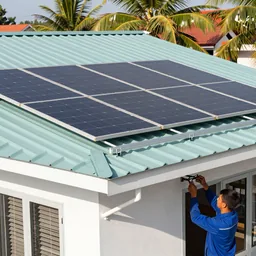
- Measurements of the roof, photos of the underside (purlins or rafters) and a note on its condition. See our roof assessment guide for what should be checked.
- A shading check for the dry and rainy seasons.
- Questions about how you use power: twelve months of bills, working hours, which machines or air-conditioners run during the day, planned expansion.
- For businesses, ideally a load logger on the main board for a week, so the design follows your actual daytime profile.
- Questions about outages and brownouts, if backup matters to you.
- Where the inverter, batteries and cables will go.
Red flag: a quote produced without anyone visiting, or without a single question about your load.
2. Is every item named with brand and model?
A quote should let you look up every major component. That means brand, model and quantity for:
- Panels (model, wattage, and whether the maker appears on the industry's Tier 1 bankability lists; see Tier 1 explained)
- Inverter, and battery with its usable kWh
- Mounting system
- DC cable type and size, and connectors from one maker (mating connectors of different brands is a known cause of overheating)
- DC isolators, DC and AC surge protection devices, breakers and earthing materials
- Monitoring device
Datasheets should be attached or available on request.
Red flag: "Tier 1 panel 550 W" without a brand, or "or equivalent" next to the key items. That lets anything be installed.
3. Can you check the design?
You do not need to be an engineer to ask for the design and see whether it exists.
| Ask for | A good answer looks like | Red flag |
|---|---|---|
| String design | Panels per string, number of strings per MPPT input, voltage checked at the coldest and hottest temperatures against the inverter limits | "The inverter will handle it" |
| DC/AC ratio | A stated ratio with a reason (on-grid systems in hot climates are commonly somewhere around 1.1 to 1.3) | No idea what it is |
| Single-line diagram | A drawing showing panels, isolators, protection, inverter, battery, main board | None |
| Yield estimate | A range, with the assumptions written (peak sun hours, losses) | One fixed number presented as a guarantee |
| Export plan | Zero-export or export-limit settings if needed, with the meter or CT location | Not mentioned |
| Backup plan (hybrid) | Which circuits are backed up and for how long, battery usable kWh and depth of discharge | "The whole building will run on battery" |
For planning, a fair estimate uses about 4.5 to 5.5 peak sun hours per day in Laos and Thailand, with lower figures in the rainy season.
4. How will they actually install it?
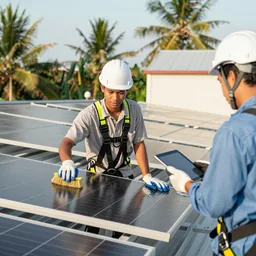
- Who installs: the company's own team or a subcontractor? Will a qualified supervisor be on site every day?
- Do they crimp connectors with the correct tool, and torque clamps and terminals to the maker's values?
- How do they seal roof fixings and cable entries?
- Are DC cables in UV-resistant conduit or tray, and are DC warning labels fitted?
- Will they send photos during the work?
5. What commissioning tests will you receive?
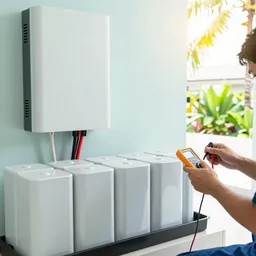
Ask for a written commissioning report with measured values, not "we switched it on and it works". It should include for each string: open-circuit voltage, current, polarity and insulation resistance; earthing continuity; inverter settings (grid profile, export limit); a functional test of the backup switchover on hybrid systems; and ideally a thermal scan once the system is running in strong sun. These values become the baseline for every future fault-finding visit.
6. What do you get at handover?
- As-built single-line diagram and a string layout map showing which panel belongs to which string
- Datasheets and the commissioning report
- Warranty certificates registered in your name with serial numbers
- Monitoring account in your name, with the installer given access
- An O&M guide and a cleaning plan
- Emergency shutdown steps posted next to the inverter
Red flag: the monitoring account belongs only to the installer, so you cannot see your own system if you part ways.
7. How will warranties be handled?
There are several warranties, and they cover different things:
- Panel product warranty: defects in materials and workmanship, often 12 to 25 years depending on maker and model.
- Panel performance warranty: a guaranteed minimum output each year, typically over 25 to 30 years.
- Inverter warranty: commonly 5 to 10 years as standard, sometimes extendable.
- Battery warranty: years and a limit on energy throughput or cycles, whichever comes first.
- Workmanship warranty: from the installer, covering their own work such as leaks and loose connections.
In Laos, most claims go through the maker's service in Thailand. Ask in writing: who diagnoses, who files the claim, who pays shipping and the labour to remove and reinstall, and roughly how long a replacement takes.
8. What happens after installation?
- Who watches the monitoring, and who receives alerts?
- How do you report a problem? A WhatsApp group with named people works well in practice.
- Does the installer keep common spare parts such as fuses, connectors and SPD cartridges?
- Is there a cleaning plan and an annual inspection offer? See the O&M checklist.
9. Ask about sourcing, lead time and spare parts
Most solar equipment for Laos comes through Thailand, so timing belongs in the quote. Ask which items are in stock and which must be ordered, and how many weeks the installer expects for delivery and border clearance. Ask what happens if a panel arrives cracked or an inverter fails in the first month: who replaces it, and whether a spare is already in Laos or must come from Thailand. Check that the inverter offered is a model sold for this region, with grid settings and warranty terms that apply here. A realistic schedule written into the quote is worth more than a fast promise that slips by a month.
Red flags in one list
- No site visit
- "Or equivalent" instead of brand and model
- A yield or savings figure presented as guaranteed
- Pressure to sign today
- No DC isolator or surge protection on the drawing
- Mixed connector brands
- Monitoring account only in the installer's name
- Brand badges or titles you cannot confirm with the maker
- Warranty handling that is never put in writing
Ten questions to copy into your email
- When will you visit the site, and what will you measure?
- Can you list every component with brand and model?
- How many panels per string, and what is the string voltage at the coldest morning?
- What DC/AC ratio did you choose and why?
- Can I see the single-line diagram?
- Which tests will be in the commissioning report?
- Will the warranty certificates and monitoring account be in my name?
- Who handles warranty claims, and who pays for shipping and labour?
- How do I report a fault, and who answers?
- Who exactly will install, and who supervises on site?
How we work
We are specialists from Thailand, and our team has installed more than 5 MW of solar PV in Thailand. We design on-grid, hybrid and off-grid systems, use Tier 1 panels, and repair and maintain systems installed by anyone. Every quote we send follows the checklist above.
Already have a quote from someone? Send it to us on WhatsApp and we will go through it with you and point out what is missing, even if you do not buy from us. For larger rooftops see commercial and industrial solar, or start at the solar overview.
- #solar
- #buying guide
- #installer
- #quotation
- #warranty
- #commissioning