 Solar PV & Energy
Commercial & Industrial Solar
Engineered solar for factory roofs, carports and ground mounts, from a few hundred kWp up to megawatt scale.
What we usually find on site
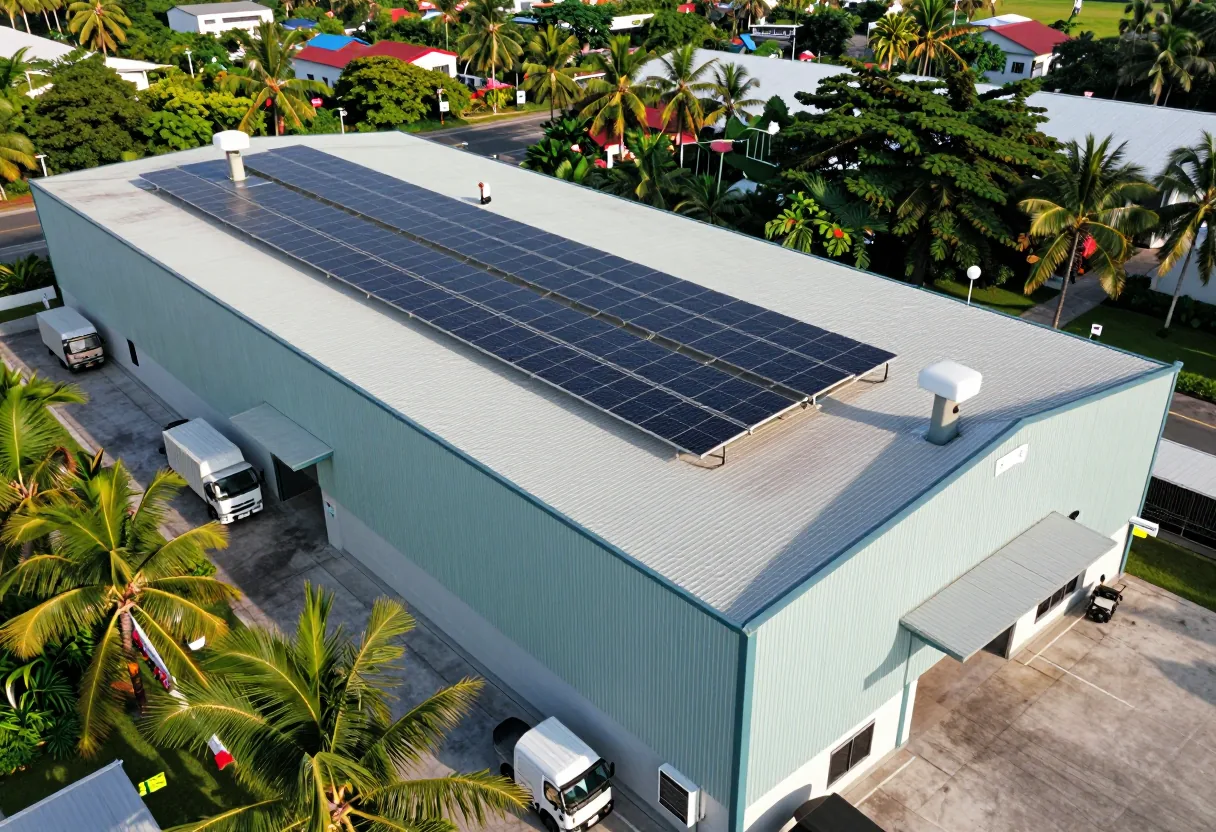
Factories, warehouses and malls use a lot of power during the day and have large roofs. At this size mistakes are large too: metal-sheet roofs that cannot carry the load, kilometres of DC cable run badly, protection that does not coordinate with the existing MDB, and nobody watching the alarms after handover.
The scale we work at
Our team has installed more than 5 MW of solar in Thailand, from small systems up to factory roofs and ground-mounted arrays. For businesses we design three layouts:
| Layout | Suits | What needs extra checking |
|---|---|---|
| Rooftop | Factories, warehouses, malls | Load capacity, roof sheet condition, fire access |
| Carport | Offices, hospitals, malls | Steel structure, foundations, wind load |
| Ground mount | Factories with spare land, mine sites | Soil survey, flooding, fencing and CCTV |
Engineering, not just laying panels
A system of several hundred kWp needs a structural check of the roof or foundations, voltage-drop calculations for DC and AC cabling, protection coordination with the existing MDB and transformer, and string layouts that give each MPPT panels facing the same way. We generally use several three-phase string inverters rather than one large central inverter: if one unit fails the rest keep producing, and a spare is small enough to bring over from Thailand quickly.
Use as much as you produce
Most factories in Laos do not export power. So we size the array to the daytime load and set an export limit with a power meter at the connection point. If the plant shuts on Sundays and load drops sharply, the system throttles itself. We show you at design stage how much energy will be curtailed.
After handover
Every string is tested and its values recorded, the array is thermally scanned under full sun, and the monitoring portal is set up so the plant's electrical team sees the same alarms we do. At this size we recommend an O&M contract from day one.
Send us the plant's single-line diagram, transformer details and daytime load profile, and we will prepare a site survey and a first sizing.
What it does
Structural check
Roof load capacity, purlins and metal sheet condition checked before design.
Distributed string inverters
One failure does not stop the whole plant, and spares are easy to stock.
Export limit control
Keeps export at zero or at the level agreed with the power utility.
Coordination with the existing MDB
Breakers, SPDs and the point of connection chosen to fit the plant's electrical system.
Fire access and walkways
Clear lanes for firefighters and cleaners, with DC cable in closed trays.
Tested and thermally scanned
Voc, Isc and insulation resistance logged per string, plus a thermal scan for hot spots before handover.
Design and rollout
- 1
Site survey: roof or land, shading, MDB, transformer and cable routes.
- 2
Log the load for 1–4 weeks and analyse daytime demand, including rest days.
- 3
Detailed design: panel layout, strings, single-line diagram, voltage drop, protection and yield estimate.
- 4
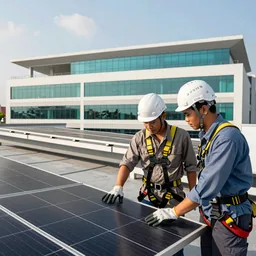
Install under a site safety plan: fall protection, work zones and lock-out procedures.
- 5
Test every string, configure inverters and the export limit, run a thermal scan.
- 6
Hand over as-built documents and start O&M with monitoring.
Where it fits
- Garment and agro-processing plants in economic zones working day shifts.
- Warehouses and cold stores with big roofs and daytime refrigeration load.
- Malls and hotels turning car parks into solar carports.
- Mine sites cutting daytime generator fuel with a ground-mounted array.
Typical system sizes
Mid-size Business
Fits: One roof, roughly 100–300 kWp
- Several three-phase string inverters
- Roof structural check
- Export limit and monitoring portal
Industrial
Fits: Several roofs or carports, roughly 300 kWp–1 MWp
- Protection coordination with MDB and transformer
- Thermal scan at commissioning
- First-year O&M contract
Ground Mount
Fits: Plants or sites with spare land, 1 MWp and above
- Soil survey and foundation design
- Fencing, access roads and CCTV
- Plant-level monitoring and a spare-parts plan
Brands we supply & install









All brand names and trademarks belong to their respective owners. Mention does not imply official partnership unless explicitly stated. Products are sourced through legitimate distribution channels.
FAQ
Can we put solar on an old metal-sheet roof?
Yes, if the structure can carry the load and the sheets are in good condition. Panels and rails add roughly 12–15 kg/m². If the sheets are rusting or have less than about ten years of life left, replace them first, because taking the array off later to re-roof is a big job.
Why not one big central inverter?
On Lao rooftops, several string inverters give more MPPTs, which handle roofs facing different ways better. If one fails the rest keep producing, and a replacement comes in from Thailand faster. Central inverters make more sense on very large ground-mounted plants.
Will voltage dips in the plant affect the solar system?
The inverters disconnect briefly if voltage or frequency leave the set window, then reconnect on their own after a few minutes. If it happens often, we log power quality and check the settings before blaming the inverter.
What should we prepare before we start?
Twelve months of bills, the plant single-line diagram, transformer rating, roof drawings if you have them, and your working hours. If drawings are missing, we measure and draw them during the survey.
Related guides
Solar System Sizing: From Your kWh Bill to kWp, Battery and Inverter
How to size panels, batteries and inverters from a monthly electricity bill and daytime load, with three worked examples: an on-grid office, a hybrid home and an…
Roof Assessment Before Solar: Structure, Waterproofing, Wind, Shading and Orientation
The roof checklist we use on site for metal sheet, tile and concrete roofs: purlins and load, waterproofing, clamps and rails, wind, shading, tilt for Lao latitudes…
Solar Inverter Types: String, Hybrid, Micro, C&I and Off-Grid Compared
How each inverter type works and where it fits, how to set the DC/AC ratio and match strings, and what to watch in the monitoring app so problems are caught early.
How to Choose a Solar Installer: The Buyer's Checklist
What should be in the quote and in the work itself: site survey, a bill of materials with brand and model, string design, commissioning tests, handover documents…
Tier 1 Solar Panels Explained, and How to Read a Panel Datasheet
What Tier 1 tells you and what it does not, how to read Pmax tolerance, temperature coefficient, degradation and the two kinds of warranty, and how TOPCon, BC, HJT…
Related solutions
Solar PV & Energy
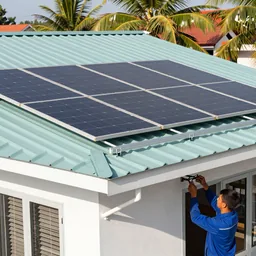 On-grid Rooftop SolarRooftop solar for homes, shops, offices and schools, sized to your daytime load, with a zero-export option.
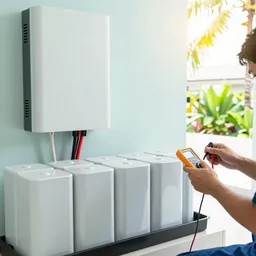 Hybrid Solar with Battery StorageHybrid inverter and LiFePO4 battery to keep power on through outages and evening brownouts, and to store daytime solar for the…
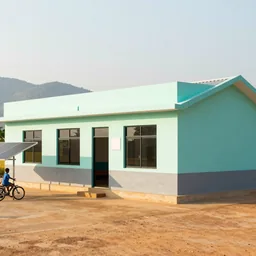 Off-grid Solar for Remote SitesStand-alone power for schools, health posts, farms, work camps and telecom sites with no grid or a weak one.
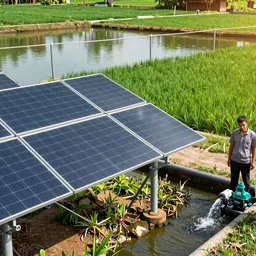 Solar Water PumpingPump from boreholes, streams or ponds with sunlight for orchards, rice fields, farms and village water supply, without fuel or a…
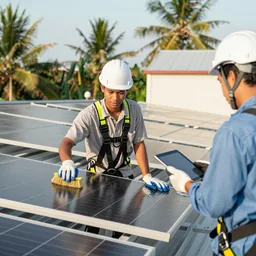 Solar O&M and MonitoringCleaning, inspection, thermal scans, string tests and performance tracking, for systems we installed and systems others installed.
 Solar Inverter & System RepairFault-code diagnosis, board-level repair where feasible, warranty claims with the maker, or replacement. Any system, whoever…
Send us a floor plan or a few photos of the site
We’ll come back with a few questions, then a first design. The first consultation is free, in Lao, Thai or English, on WhatsApp or our Facebook page.