 Solar PV & Energy
On-grid Rooftop Solar
Rooftop solar for homes, shops, offices and schools, sized to your daytime load, with a zero-export option.
What we usually find on site
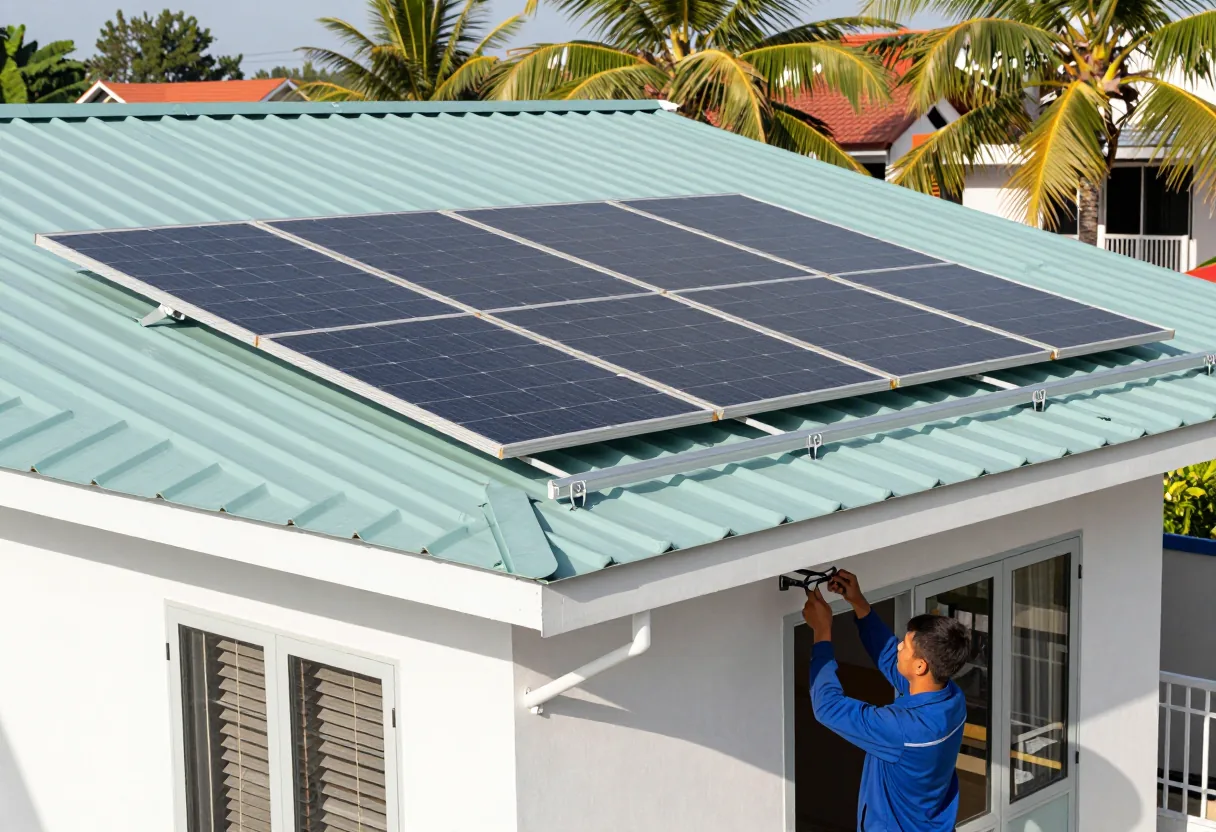
Most buildings use the most power during the day: air conditioning, fridges, computers and water pumps. An empty roof can produce that power on site. What we often find instead are systems oversized for the load, miswired strings, no surge protection or earthing, and roofs that leak after the first rainy season.
How an on-grid system works
Panels produce DC power, the on-grid inverter turns it into AC and feeds the building's switchboard. The building uses solar power first and draws the rest from the grid as usual. There is no battery, so when the grid goes down the inverter stops by itself (anti-islanding) to protect line workers who may be repairing the network. If you need power during outages, look at hybrid solar with battery.
Sized to your daytime load
We start from twelve months of electricity bills and, where possible, one to two weeks of measured load. What matters is the daytime base load (09:00–15:00), not the monthly total. A system larger than the daytime load overproduces, and with zero-export set, that surplus is simply curtailed.
An example: an office that steadily draws about 8 kW during the day suits a system of roughly 8–10 kWp. With about 4.5–5.5 kWh/m²/day of sun across Laos and Thailand, a 10 kWp system makes roughly 35–45 kWh on a good day and less in the rainy season. That is an estimate, not a guarantee.
Zero-export and export limiting
Many buildings do not want, or are not able, to push power back into the grid. We install a smart meter or CT on the incoming supply; the inverter reads it and throttles its own output so nothing flows out. We coordinate the grid connection with the local power utility for you.
What makes a system last 25 years
- Tier 1 panels and an inverter named by brand and model on the quote
- String sizing checked against Voc on the coldest morning and voltage on a 70°C roof
- DC isolators, SPDs on both DC and AC sides, and measured earthing
- MC4 connectors of the same make on both halves of every joint, never mixed brands
- A structural check of the roof and waterproofing at every penetration
Send us photos of your roof and your last three electricity bills on WhatsApp. We will tell you what system size makes sense and what we need to check on the site visit.
What it does
Sized from real load
Based on daytime load and 12 months of bills, not on how much roof there is.
Zero-export with a smart meter
The inverter throttles back when building load drops, so no power flows out to the grid.
Tier 1 panels, checkable equipment
Every quote names the brand, model and datasheet of the panels and inverter.
DC-side safety
DC isolators, SPDs, string fuses where needed and DC cable run in UV-resistant conduit.
Monitoring app
Daily and per-string production on your phone. With your permission, we see the same alarms.
A roof that stays dry
Mounting matched to the roof type (metal sheet, tile, concrete slab) and sealed at every fixing.
Design and rollout
- 1
Roof survey: orientation, pitch, shading from trees and neighbouring buildings, condition of the roof structure.
- 2
Load and bill analysis, then choose kWp and inverter size.
- 3
String design, single-line diagram and yield estimate, with a bill of materials naming brand and model.
- 4
Install mounting, panels, inverter, DC/AC boxes, SPDs and earthing.
- 5
Commissioning: Voc and Isc on every string, insulation resistance, polarity, earth continuity, inverter and zero-export settings.
- 6
Handover documents, monitoring app set-up and a walk-through on how to shut the system down safely.
Where it fits
- Offices in Vientiane running air conditioning all day.
- Schools that use most of their power during class hours and have large roofs.
- Shops, minimarts and restaurants with chillers running all day.
- Homes occupied during the day with air conditioning or water pumps.
- Government offices and service buildings working 08:00–16:00.
Typical system sizes
Home & Shop
Fits: Single- or three-phase supply, one roof, roughly 3–15 kWp
- One string inverter with monitoring app
- Zero-export with smart meter if required
- DC and AC surge protection, earthing
Office & School
Fits: Three-phase supply, 1–3 building roofs, roughly 15–100 kWp
- One or more three-phase inverters
- Load logging before design and a yield estimate
- Roof walkways for cleaning and inspection
Multi-building
Fits: Campuses or branch networks that want one view across sites
- Per-building design matched to each building's load
- One monitoring portal across all sites
- Yearly O&M and cleaning plan
Brands we supply & install










All brand names and trademarks belong to their respective owners. Mention does not imply official partnership unless explicitly stated. Products are sourced through legitimate distribution channels.
FAQ
Does an on-grid system work during an outage?
No. An on-grid inverter must stop when the grid fails so it cannot energise lines that crews are repairing. For power during outages you need a hybrid system with a battery. Many systems can add a battery later if you choose a battery-ready inverter from the start.
How much roof does a 10 kWp system need?
Current panels are about 580–620 W each and about 2.6 m² in area. A 10 kWp system therefore needs around 17 panels, or roughly 50–60 m² including gaps and walkways. Roof area shaded between 09:00 and 15:00 should not be counted.
Do panels degrade fast in the Lao heat?
Current n-type panels degrade about 0.4% a year after the first year, and makers give a 25–30 year performance warranty. Heat does not speed up degradation much, but it lowers output on the day: a panel at 65°C produces roughly 10–14% less than its label, depending on panel type. Leaving an air gap under the panels helps.
How often should panels be cleaned?
In town usually 2–4 times a year, especially at the end of the dry season when dust and smoke from field burning are heavy. Near dusty roads or factories it may need to be more often. Use clean water and a soft brush, never a pressure washer.
Related guides
On-Grid, Hybrid or Off-Grid Solar: Which System Fits Your Site?
How the three solar system types behave when the grid fails, what each needs on site, and how to choose for an office, factory, school or remote camp in Laos.
Solar System Sizing: From Your kWh Bill to kWp, Battery and Inverter
How to size panels, batteries and inverters from a monthly electricity bill and daytime load, with three worked examples: an on-grid office, a hybrid home and an…
Roof Assessment Before Solar: Structure, Waterproofing, Wind, Shading and Orientation
The roof checklist we use on site for metal sheet, tile and concrete roofs: purlins and load, waterproofing, clamps and rails, wind, shading, tilt for Lao latitudes…
Tier 1 Solar Panels Explained, and How to Read a Panel Datasheet
What Tier 1 tells you and what it does not, how to read Pmax tolerance, temperature coefficient, degradation and the two kinds of warranty, and how TOPCon, BC, HJT…
How to Choose a Solar Installer: The Buyer's Checklist
What should be in the quote and in the work itself: site survey, a bill of materials with brand and model, string design, commissioning tests, handover documents…
Solar for Schools and Public Buildings: Design, Safety and Upkeep
Schools and offices use power in daylight, which is when solar produces. How to size from the load, choose zero-export on-grid, hybrid or off-grid for remote schools…
Related solutions
Solar PV & Energy
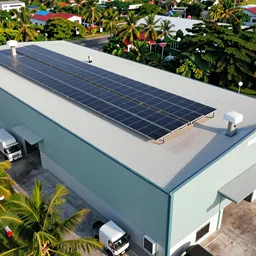 Commercial & Industrial SolarEngineered solar for factory roofs, carports and ground mounts, from a few hundred kWp up to megawatt scale.
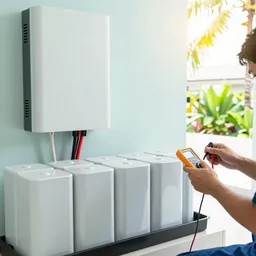 Hybrid Solar with Battery StorageHybrid inverter and LiFePO4 battery to keep power on through outages and evening brownouts, and to store daytime solar for the…
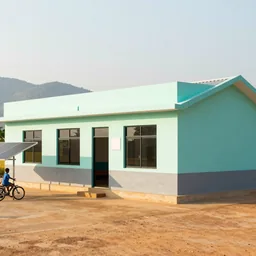 Off-grid Solar for Remote SitesStand-alone power for schools, health posts, farms, work camps and telecom sites with no grid or a weak one.
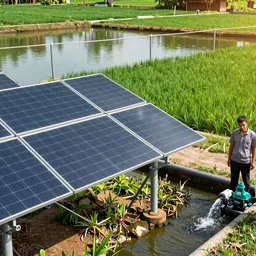 Solar Water PumpingPump from boreholes, streams or ponds with sunlight for orchards, rice fields, farms and village water supply, without fuel or a…
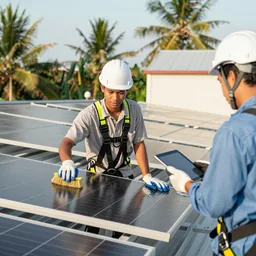 Solar O&M and MonitoringCleaning, inspection, thermal scans, string tests and performance tracking, for systems we installed and systems others installed.
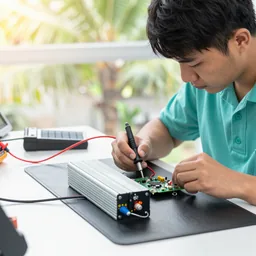 Solar Inverter & System RepairFault-code diagnosis, board-level repair where feasible, warranty claims with the maker, or replacement. Any system, whoever…
Send us a floor plan or a few photos of the site
We’ll come back with a few questions, then a first design. The first consultation is free, in Lao, Thai or English, on WhatsApp or our Facebook page.