On this page
- A 10 kWh battery does not give you 10 kWh
- Why LiFePO4
- LiFePO4 compared with lead-acid
- DoD, cycles and what "6,000 cycles" really means
- Reading a battery warranty
- The BMS: the battery's brain
- Heat: the battery's main enemy in Laos
- Sizing a battery for backup hours
- Low-voltage vs high-voltage, and adding modules
- Common mistakes
- Safety
- How we can help
A 10 kWh battery does not give you 10 kWh
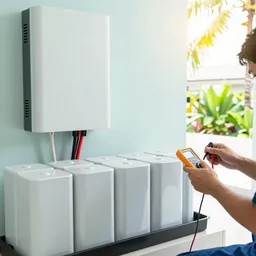
Many hybrid system owners call us with the same question: "We have a 10 kWh battery, so why is it empty after a three-hour outage?" The answer is usually a bigger load than expected, depth of discharge and losses that nobody subtracted, or a battery kept somewhere hot that has aged early. The battery is often the most misunderstood part of a solar system. This guide explains how to choose, size and install a LiFePO4 battery so that it lasts and stays safe.
Why LiFePO4
LiFePO4 (lithium iron phosphate, or LFP) is a lithium chemistry that is far more thermally stable than the chemistries used in phones and many electric cars. Thermal runaway starts at a higher temperature and releases less energy. For a battery mounted inside a building, that matters. It also cycles thousands of times, holds an almost flat voltage through most of the discharge, has high round-trip efficiency, and needs no topping up or venting like flooded lead-acid.
LiFePO4 compared with lead-acid
| LiFePO4 | Lead-acid (AGM / Gel) | |
|---|---|---|
| Usable everyday DoD | About 80–90% | About 50% for a decent life |
| Datasheet cycle rating | Often 6,000 cycles or more under test conditions | A few hundred to about 1,500, depending on type and DoD |
| Round-trip efficiency | High, about 95% on the DC side | Noticeably lower |
| Charging speed | Fast | Slow, especially near full |
| Heat | Ages faster when hot | Ages much faster when hot |
| Weight | Much lighter | Heavy |
| BMS required | Yes | No |
Lead-acid still has a place in small UPS units and older systems that are only used occasionally. But for a solar system that charges and discharges every day, LiFePO4 lasts many times longer. In the heat of Laos, we regularly see lead-acid banks in solar systems needing replacement within a few years.
DoD, cycles and what "6,000 cycles" really means
Depth of discharge (DoD) is the share of capacity used in each cycle. A 10 kWh battery set to stop discharging at 10% state of charge (SOC) uses a DoD of 90%, giving about 9 kWh before inverter losses.
The "6,000 cycles" on a datasheet is measured under specific conditions: about 25°C, modest charge and discharge currents, a defined DoD, and counted until capacity falls to about 70–80% of the original. It does not mean the battery dies after 6,000 cycles, and it does not promise your battery will reach 6,000 cycles if your conditions differ. A slightly lower DoD, moderate currents and a cool location all help the battery last longer.
Reading a battery warranty
Most battery warranties have two limits and end at whichever comes first:
- a number of years, and
- a number of cycles or a total energy throughput (in MWh)
Read the conditions too: the allowed temperature range, a requirement to communicate with a supported inverter, registration, and an online monitoring connection. A battery installed somewhere hotter than allowed may have its claim refused. Also ask where a battery imported through Thailand would be claimed and how long that takes.
The BMS: the battery's brain
Every LiFePO4 battery needs a BMS (battery management system). It:
- watches each cell's voltage and disconnects if it goes too high or too low
- disconnects on over-current or short circuit
- blocks charging when too cold and limits it when too hot
- balances the cells
- calculates SOC and tells the inverter what charge voltage and current to use, over CAN or RS485
When the inverter and BMS communicate (closed-loop), the inverter charges as the battery asks. Without communication, the inverter has to estimate SOC from voltage, which is inaccurate for LiFePO4 because its voltage stays nearly flat. So use only inverter and battery pairs that the makers support. If the SOC in the app drifts, let the battery reach 100% from time to time so the BMS can recalibrate.
Heat: the battery's main enemy in Laos
The warning you will read most often about LiFePO4 is "do not charge below 0°C". In Laos this is rarely a problem outside the odd cool-season morning in the highlands, and a good BMS blocks it anyway. Our real problem is heat. Battery life is rated at about 25°C. Every degree above that, sustained over time, speeds up ageing, even though the datasheet may allow operation up to around 50°C.
What we do on site:
- Mount the battery indoors in the shade, not on a west wall and never in a steel cabinet in the sun
- Aim to keep the battery room from running above about 30–35°C for long periods
- Leave the clearances around the battery that the maker specifies
- Larger battery rooms get an extract fan or air conditioning plus a temperature sensor
Sizing a battery for backup hours
Battery energy (kWh) = load (kW) × hours ÷ (DoD × inverter efficiency)
Then allow for ageing: a battery near the end of its warranty may hold only about 70–80% of its original capacity.
Example: a small clinic wants lighting, a medicine fridge, computers, the network and fans to run for 6 hours during an outage. The average load is about 1.2 kW.
- Energy needed: 1.2 × 6 = 7.2 kWh
- Divide by DoD 0.9 and efficiency 0.92: 7.2 ÷ 0.83 ≈ 8.7 kWh
- Allow for ageing: choose about 10–12 kWh
Do not forget power as well as energy. The battery must deliver enough current for the inverter's full backup power. A 48 V battery rated for 100 A continuous gives about 5 kW. Pair it with an 8 kW inverter that must deliver full power, and you need several modules in parallel. For a first estimate you can use our UPS runtime calculator.
Low-voltage vs high-voltage, and adding modules
Low-voltage 48 V batteries are common in homes and offices, and capacity grows by adding modules in parallel. High-voltage batteries (several hundred volts) stack modules in series and work with high-voltage hybrid inverters, with lower cable currents. The two are not interchangeable. When adding modules later, use the same model and firmware, and bring the SOC close together before connecting. A new module next to modules that have worked for years will run, but total usable capacity is limited by the most aged module.
Common mistakes
- Sizing from the nameplate kWh without subtracting DoD, losses and ageing.
- Putting air conditioners or water heaters on the backup circuit, then wondering why the battery empties so fast.
- Letting the battery discharge to 0% every night to squeeze out the most energy. Keep 10–20% in reserve for outages, which also helps the battery last.
- Mixing brands or models in the same battery bank.
- Never opening the monitoring, so nobody notices one cell drifting out of balance or temperatures creeping up.
Safety
- Fit a correctly rated DC breaker or fuse close to the battery, and use cable of adequate cross-section, kept as short as practical
- Tighten terminal lugs to the specified torque. A loose lug becomes a hot spot and can start a fire
- Do not install in a bedroom or on an escape route, and keep combustibles away
- Put a smoke detector in the battery room
- Choose batteries tested to international standards such as IEC 62619, and UN38.3 for transport
- Lithium batteries travel across borders as dangerous goods, so allow extra time for orders and warranty returns through Thailand
How we can help
We design and install hybrid systems with battery and off-grid systems, and our team has installed more than 5 MW of solar PV in Thailand. We pair inverters and batteries that their makers support, place the battery somewhere cool enough, and test communication and changeover before handover. If your battery runs out sooner than it should, send us a screenshot of the SOC and a list of what is connected, and we will help find the cause. For servers and network equipment that must never blink, see UPS and power protection as well.
- #solar
- #battery
- #lifepo4
- #energy-storage
- #bms
- #backup-power