On this page
- "We want 10 kW": 10 kW of what?
- Six terms to keep apart
- The one formula we always use
- Step 1: read the bill properly
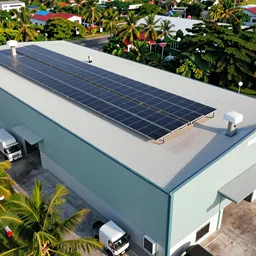
- Worked example 1: an on-grid office with daytime load
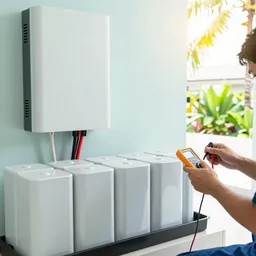
- Worked example 2: a hybrid home that needs evening backup
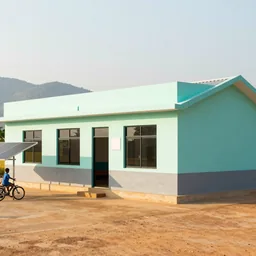
- Worked example 3: an off-grid health post
- Step 2: check the roof
- Step 3: match the panels to the inverter
- Common mistakes
- How we can help
"We want 10 kW": 10 kW of what?
The request we hear most often is a single number: "we want 10 kW". That number could mean panel capacity, inverter size, battery size or the building's peak load, and those are four different things. This guide shows how we actually size a system from information you already have: your electricity bill and the shape of your daily load.
Six terms to keep apart
- kW: power at a moment in time. A 1.5 kW air conditioner draws 1.5 kW while its compressor runs.
- kWh: energy, the number on your bill. 1.5 kW for 2 hours = 3 kWh.
- kWp: the panels' peak rating under standard test conditions (STC). Twenty 600 W panels = 12 kWp.
- Peak sun hours (PSH): the number of hours of equivalent full sun (1,000 W/m²) in a day. Across Laos and Thailand this averages about 4.5–5.5 per day, lower in the rainy season.
- Performance ratio (PR): what is left after losses from heat, dust, wiring and the inverter. In hot, dusty conditions we usually work with about 0.75–0.80.
- DC/AC ratio: panel kWp divided by inverter kW. Usually around 1.1–1.3.
The one formula we always use
Daily energy (kWh) ≈ kWp × PSH × PR
With PSH 4.5 and PR 0.75, 1 kWp of panels gives about 3.4 kWh a day. With PSH 5.5 and PR 0.80 it gives about 4.4 kWh. A sensible range is therefore about 3.4–4.4 kWh per kWp per day, and less in the wettest months. This is a design estimate, not a yield guarantee. Weather changes from year to year.
Step 1: read the bill properly
Ask for 12 months of bills if you can. The three hottest months (March to May) usually show the highest use because of air conditioning. Then ask how much of that energy is used in daylight. The bill does not tell you. For a commercial building the best answer comes from an energy logger on the main board for 7 days, which shows the load every 15 minutes. Without one, walk the building and list what runs between 8:00 and 17:00.
Worked example 1: an on-grid office with daytime load
Inputs: an office working Monday to Saturday, average bill 3,000 kWh per month. The logger shows about 70% of that is used between 8:00 and 17:00.
- Daytime energy per working day: 3,000 × 0.70 ÷ 26 ≈ 81 kWh
- Average daytime load: 81 ÷ 9 hours ≈ 9 kW (higher in the afternoon, lower in the morning)
- Goal: use almost all solar on site, no export (zero-export)
- Try 12 kWp: daily energy ≈ 12 × 4.5 × 0.78 ≈ 42 kWh. At noon in hot weather, a 12 kWp array typically delivers about 8.5–9.5 kW of real output, close to the daytime load.
- Inverter: 10 kW, giving a DC/AC ratio of about 1.2
Result: solar covers roughly half of the daytime energy, and almost every kWh is used in the building. Go to 20 kWp and, on Sundays and holidays when the load is low, zero-export will throw a lot of that production away. This is why we size to the daytime load, not to the whole monthly bill.
Worked example 2: a hybrid home that needs evening backup
Inputs: a home using about 450 kWh per month (about 15 kWh a day). Outages are common between 18:00 and 22:00. The owners want essential loads to run for 4 hours.
Backup load list:
| Load | Average power |
|---|---|
| LED lighting, whole house | 150 W |
| Router and ONT | 30 W |
| Fridge (averaged over its cycle) | 100 W |
| TV | 100 W |
| Two fans | 120 W |
| NVR and 4 cameras | 60 W |
| Total | about 560 W |
- Energy needed: 0.56 kW × 4 hours ≈ 2.2 kWh
- Divide by usable depth of discharge (0.9) and inverter efficiency (0.9): 2.2 ÷ 0.81 ≈ 2.8 kWh
- Allow for battery ageing and heavier evenings: choose a LiFePO4 battery of about 5 kWh
- Hybrid inverter: 5 kW covers the fridge's starting surge plus daytime loads
- Panels: 5 kWp gives about 17 kWh a day on a good day, enough for daytime use and a full battery recharge
Want an air conditioner on backup as well? One unit averaging about 1 kW adds another 4 kWh over 4 hours, and the battery nearly doubles. You can estimate runtime for other loads with our UPS runtime calculator, which uses the same logic.
Worked example 3: an off-grid health post
Inputs: no grid. Loads are lighting, a medicine fridge, a laptop, internet equipment and fans.
| Load | Basis | Wh per day |
|---|---|---|
| LED lights 6 × 10 W | 6 hours | 360 |
| Medicine fridge | from datasheet | 1,000 |
| Laptop 60 W | 6 hours | 360 |
| Router 15 W | 24 hours | 360 |
| Fans 2 × 50 W | 8 hours | 800 |
| Total | about 2,900 |
- Add battery and inverter losses (about 15%): 2.9 ÷ 0.85 ≈ 3.4 kWh per day
- Size the panels for the wettest month. Assume a cautious PSH such as 3.5 and PR 0.75: 3.4 ÷ (3.5 × 0.75) ≈ 1.3 kWp. Choose 2 kWp so the battery can recover after a dull day.
- Battery for 2 days of autonomy: 2.9 × 2 ÷ 0.8 (DoD) ≈ 7.3 kWh, so choose about 7.5–10 kWh
- Off-grid inverter: 3 kW covers the whole load and the fridge's starting surge
At sites like this we usually recommend a connection point for a small generator, to recharge the battery when rain lasts longer than the design assumed.
Step 2: check the roof
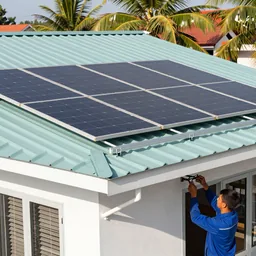
- Area: current panels measure roughly 2.0–2.8 m² each. On a metal-sheet roof, allow about 5–7 m² per kWp including gaps and walkways. Flat roofs with tilted rows need more, so the front row does not shade the one behind.
- Weight: panels plus rails typically add about 12–15 kg/m². Older roof structures need an engineer's check first.
- Orientation and tilt: in Laos, facing south at about 10–15° works well. East-west layouts also work, with slightly lower daily yield. Avoid tilts below about 10°, because rain then cleans the dust off poorly.
- Shade: antennas, water tanks, trees and neighbouring buildings. A small shadow on one panel can pull down the output of the whole string.
Step 3: match the panels to the inverter
For every string, the open-circuit voltage (Voc) on the coldest morning must stay below the inverter's maximum DC voltage. Voc rises as temperature falls, so use the site's lowest temperature (northern highland mornings in the cool season can be quite cold) together with the Voc temperature coefficient from the datasheet. At the other end, the operating voltage (Vmp) on the hottest afternoon must stay inside the inverter's MPPT range. Newer panels also carry higher currents, so check the maximum input current per MPPT as well.
Common mistakes
- Sizing from the monthly bill without asking when the energy is used.
- Using the best month's PSH and promising that output every day.
- Forgetting that zero-export throws away production on low-load days.
- Sizing the battery from the nameplate kWh without allowing for DoD and losses.
- Skipping the cold-morning Voc check, which can damage the inverter.
How we can help
We are specialists from Thailand, and our team has designed and installed more than 5 MW of solar PV in Thailand. On every job we survey the site, analyse bills and load, check shading and the roof structure, and then produce the string layout, a single-line diagram and a yield estimate, together with a bill of materials listing brand and model. Send us 3 to 12 months of bills and a few photos of the roof, and we will come back with a first sizing. If you are still deciding which system type you need, read on-grid, hybrid or off-grid first, or see our commercial and industrial systems.
- #solar
- #sizing
- #kwp
- #kwh
- #peak-sun-hours
- #battery-sizing