On this page
- The quote says "Tier 1 panels". What does that actually tell you?
- Tier 1 is a financial ranking, not a quality test
- What Tier 1 does not guarantee
- Reading a datasheet: the fields we check first
- TOPCon, BC, HJT: choosing a cell technology
- Bifacial and glass-glass
- Handling and installation that keep the warranty valid
- Checklist before you sign
- How we can help
The quote says "Tier 1 panels". What does that actually tell you?
Almost every solar quote you receive will say the panels are Tier 1. We use Tier 1 panels too. But the term is often read as a quality mark, and it is not one. This guide explains what Tier 1 means, what it does not guarantee, and what to read on a panel datasheet before you sign anything.
Tier 1 is a financial ranking, not a quality test
The Tier 1 list groups module makers by bankability. A maker qualifies when its own-brand modules, made in its own factories, have been used in several large projects that were financed on a non-recourse basis by several different banks within roughly the last two years. Makers that are bankrupt or under insolvency protection are excluded. The list is reviewed every quarter, so makers move on and off it.
In plain words: large banks are willing to lend to projects that use this brand. That is a good sign the company has scale and is likely to still exist to honour a 25–30 year warranty. For something that will sit on your roof for thirty years, that really does matter.
What Tier 1 does not guarantee
- The quality of the model or batch you receive. One maker runs many factories and many production lines. Tier 1 classifies companies, it does not test individual panels.
- That the panels are genuine. Relabelled and counterfeit panels exist. Check serial numbers with the maker and ask for the flash-test report for each pallet.
- Warranty service in Laos. Panels imported through Thailand need an importer or agent who will handle claims. Ask who files the claim and what evidence they need.
- A correct installation. A Tier 1 panel connected with mixed-brand MC4 connectors, cracked internally (micro-cracks) by someone walking on it during handling, or clamped in the wrong place will still fail.
Reading a datasheet: the fields we check first
| Field | What it means | What you want to see |
|---|---|---|
| Pmax and power tolerance | Rated power at STC and allowed deviation | Positive tolerance only, such as 0 to +5 W |
| Module efficiency | Share of sunlight turned into electricity | About 21–24% for mainstream panels in 2025–2026 |
| Voc, Isc, Vmp, Imp | Voltages and currents for string design | Isc of large panels is often about 13–19 A, and must suit the inverter |
| Pmax temperature coefficient | % power lost per °C above 25°C | The closer to zero, the better |
| NMOT or NOCT | Cell temperature in near-real conditions | Useful for comparing models |
| First-year and annual degradation | Values guaranteed in the performance warranty | Read both, plus the end-of-warranty value |
| Mechanical load | Wind and snow load rating (Pa) | Check against the maker's approved clamping method |
| Maximum system voltage | Highest DC system voltage | Usually 1,500 V |
| Test standards | Such as IEC 61215 and IEC 61730 | Check the certificate covers that exact model |
Temperature coefficient: the number that matters most in hot weather
The Pmax on the label is measured at a cell temperature of 25°C. On a metal roof in Laos on a dry-season afternoon, cell temperatures of 60–70°C are normal. At 65°C, which is 40°C above 25°C:
- a panel with a coefficient of −0.30%/°C loses about 12% of its power
- a panel with a coefficient of −0.25%/°C loses about 10%
Those two percentage points repeat on every hot day for the life of the panel. On current datasheets we see PERC at about −0.34 to −0.35%/°C, TOPCon at about −0.29 to −0.30%/°C, HJT at about −0.24 to −0.26%/°C, and BC mostly between −0.26 and −0.30%/°C. Always check the figure for the exact model being offered.
Degradation: read three numbers
A performance warranty usually says: no more than X% loss in the first year, no more than Y% per year after that, and at least Z% of rated power at the end (year 25 or 30). Current n-type panels commonly guarantee about 1% in the first year and about 0.4% per year afterwards. Do not look only at the annual figure. The first-year and end-of-warranty values tell you more.
Two warranties people confuse
- Product warranty: covers materials and workmanship, such as a burnt junction box, glass that breaks on its own or a peeling backsheet. Today this is commonly about 12–25 years depending on the model. This is the warranty you actually use when a panel fails.
- Performance warranty: guarantees power will not fall below a set line, usually for 25–30 years. Claiming it requires credible measurements, which is much harder.
When you compare quotes, look at the product warranty first. The "30 years" in a brochure is usually the performance warranty.
TOPCon, BC, HJT: choosing a cell technology
| Technology | Strengths | What to know |
|---|---|---|
| PERC (p-type) | The former mainstream | Being phased out, weaker temperature coefficient |
| TOPCon (n-type) | Today's mainstream, easy to source | Middle-of-the-range coefficient, a sensible choice for most jobs |
| BC (back contact) | No metal lines on the front, high efficiency, clean look | Worth it when roof space is limited |
| HJT (heterojunction) | Best temperature coefficient, slow degradation | Fewer makers, so check availability through Thailand |
For most jobs in Laos, TOPCon panels from a Tier 1 maker are a good starting point. When the roof is small and you need the most kWp from it, BC is worth considering. When heat is the main concern and supply is available, HJT has a real advantage.
Bifacial and glass-glass
Bifacial panels collect light on both faces, with the rear side catching light reflected from the ground. On carports or ground mounts above a light-coloured surface, that gain is meaningful. On a metal roof where the panels sit low and close to the sheeting, there is almost nothing to gain, so do not pay for a bifacial yield figure that will never happen.
Glass-glass panels use glass on both sides instead of a plastic backsheet. They resist moisture and PID better, which suits the heat, humidity and long rainy season in Laos. They are heavier, and need more care when carried and walked near. Panels near livestock housing should have an ammonia corrosion test result (IEC 62716).
Handling and installation that keep the warranty valid
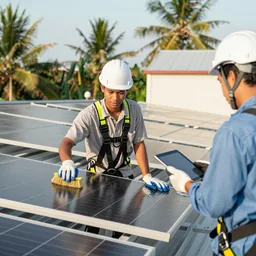
The maker's installation manual matters as much as the datasheet. It defines where on the frame the panel may be clamped, which clamps to use and what torque to apply. Clamp outside those zones and the mechanical load rating on the datasheet no longer applies, and the maker may refuse a claim. On site we keep panels boxed until the day they go up, lift them with two people, never stand on them and never rest tools on the glass. MC4 connectors must be crimped with the correct tool and tightened properly, because a loose connector is one of the most common causes of hot spots on a roof.
Checklist before you sign
- The panel brand and model are written clearly on the quote, not just "Tier 1".
- You have the datasheet and warranty document for that exact model.
- Power tolerance is positive only.
- You know who files a warranty claim and roughly how long the route through Thailand takes.
- Serial numbers and flash-test reports are kept on file.
- MC4 connectors are the same brand and type on both sides of every joint.
How we can help
We use panels from makers on the industry's Tier 1 bankability lists, and every quote we send names the brand and model with its datasheet. Our team has installed more than 5 MW of solar PV in Thailand. If you are holding a quote from someone else and would like a second pair of eyes on the panel datasheet, send it to us and we will point out which fields to ask more about. For systems already installed, the thermal-camera inspection in our O&M and monitoring service finds panels with hot spots or failed cells, which is the evidence a warranty claim needs. See our solar page for everything else we do.
- #solar
- #solar-panels
- #tier-1
- #datasheet
- #topcon
- #bifacial