On this page
- Most lost energy is visible from the monitoring app
- Why Lao conditions need their own cleaning plan
- A cleaning schedule you can start with
- How to clean safely
- Monthly checklist (owner's staff)
- Quarterly checklist (technician)
- Annual checklist (technician)
- Thermal scans: what they find
- The numbers that tell you something
- Keep a logbook
- Mistakes we commonly see
- Send us your numbers
Most lost energy is visible from the monitoring app
A solar system rarely fails loudly. More often it slowly produces less: a layer of dust after the dry season, ash during the burning season, a bird-dropping hot spot, one string that tripped three weeks ago and nobody noticed. The panels still look fine from the car park. The only way to catch these losses is a simple routine: look at the numbers, clean when the numbers say so, and inspect on a schedule.
This checklist is what we use for systems we maintain, written so that an owner's staff can do the monthly part themselves.
Why Lao conditions need their own cleaning plan
Rain does a good job of washing tilted panels from about June to October. The problems sit in the other months:
- Cool dry season (November to January): dust from unpaved roads, construction sites and fields builds up week by week.
- Burning season (roughly February to April): smoke and ash settle as a sticky film that light rain does not remove. This is also when the sun is strong and production should be high, so the loss hurts most.
- First rains (May): the first showers often turn dust into mud lines along the lower edge of the panels, especially on low-tilt arrays.
- All year: bird droppings, leaves, cement or quarry dust near industrial sites.
Low tilt makes everything worse. Panels below about 10° do not self-clean well, which is one reason we avoid flat mounting (see the roof assessment guide).
A cleaning schedule you can start with
| Period | Typical condition | Starting frequency |
|---|---|---|
| June to October | Rain washes tilted panels | Spot-clean bird droppings only |
| November to January | Dust builds up | Every 6 to 8 weeks |
| February to April | Ash and smoke film | Every 2 to 4 weeks on dusty sites |
| May | Mud lines after first rains | One full clean |
Treat this as a starting point. The right frequency for your site comes from data: clean one row or one string first, then compare its output with an uncleaned string on the next clear day. If the cleaned string produces clearly more, clean the rest. If the difference is tiny, you are cleaning too often.
How to clean safely
Protect the people
- Panels produce DC voltage whenever there is daylight. Covering them does not make the cables safe. Do not touch connectors or cables, and do not open junction boxes.
- Before wetting anything, look for broken glass, cracked back sheets or damaged cables. Broken panels plus water can give an electric shock. Stop and call a technician instead.
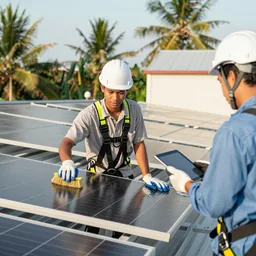
- Work at height properly: a safe ladder or access hatch, a harness clipped to an anchor point on pitched roofs, and two people, never one alone.
- Do not clean in rain, strong wind or when thunderstorms are near.
Protect the panels
- Clean early in the morning or late in the afternoon. Cold water on hot glass at midday stresses the glass, and water dries into spots.
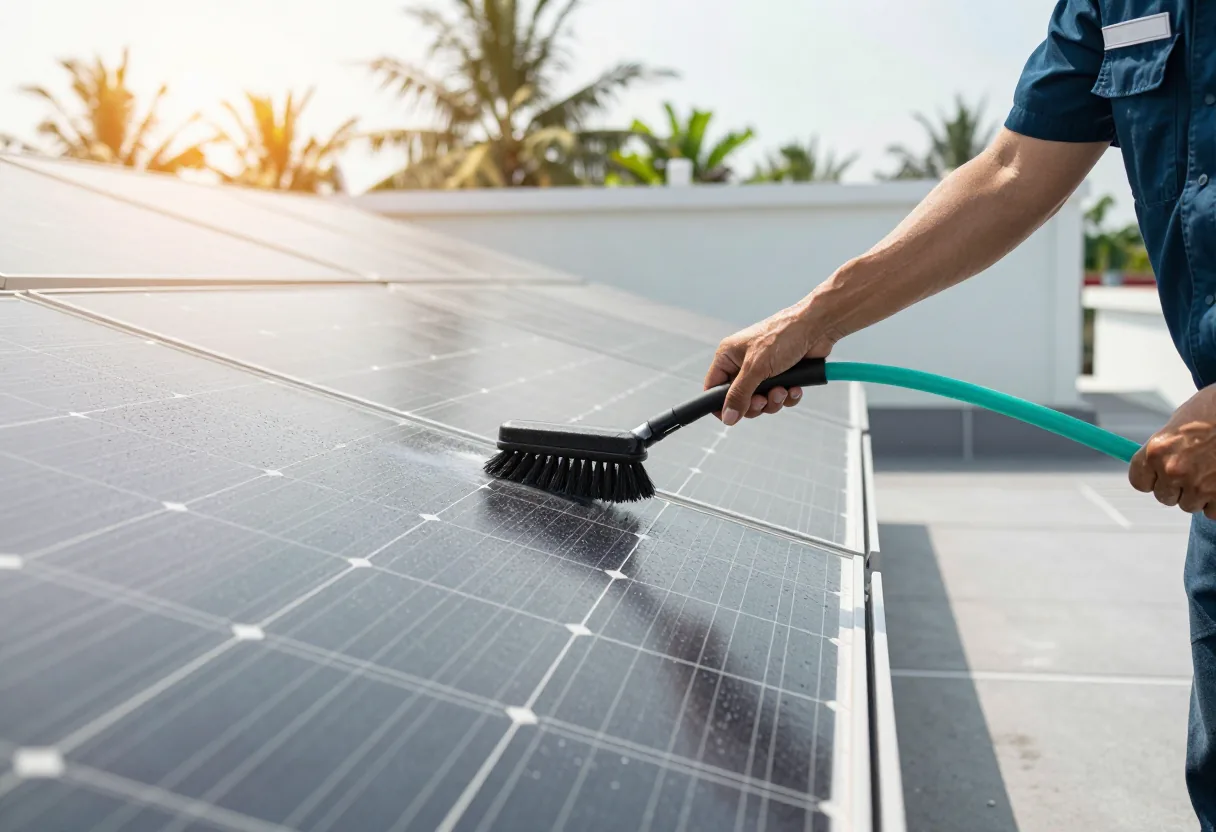
- Use clean, soft water. Hard well water leaves a mineral film; filtered water is better where the water is hard.
- Use a soft brush, sponge or squeegee on a pole. No abrasive powders, metal scrapers or strong detergents unless the panel maker's manual allows a mild one.
- Do not use a high-pressure jet close to the panel. Many panel makers limit water pressure in their manuals, and a jet aimed at frame edges or junction boxes can push water past the seals.
- Never stand, kneel or walk on panels. It causes micro-cracks that become hot spots months later.
- Do not spray the inverter, combiner boxes or switchboards.
Always read the cleaning section of your panel maker's installation manual. Damage from a cleaning method the maker forbids is usually not covered by warranty.
Monthly checklist (owner's staff)
- Open the monitoring app at least weekly. Is today's energy similar to other clear days? Are there alarms?
- Check the inverter display or LEDs and photograph any fault message.
- From a safe place, look for dirt, bird droppings, leaves and new shade from growing trees.
- Keep the inverter area clear: nothing stacked against it, ventilation openings and fans free of dust and insect nests.
- Write the energy meter reading in a logbook.
Quarterly checklist (technician)
- Clean as the data shows is needed.
- Inspect panels for cracked glass, browning, snail trails, delamination or damaged junction boxes.
- Inspect cables for UV damage, rodent bites (common on Lao sites), broken cable ties and cables lying on the roof surface.
- Check connectors for discolouration or heat with a thermal camera while the system is running.
- Check clamps and rails for looseness and rust against the torque marks.
- Check the indicator windows on DC and AC surge protection devices, and operate isolators and breakers.
- Read inverter event logs and check firmware.
- For hybrid systems, read BMS alarms, cell voltage spread, battery temperature and the state-of-charge history.
Annual checklist (technician)
- Measure each string's open-circuit voltage (Voc) and short-circuit or operating current, and compare them with the commissioning records, corrected for sunlight and temperature.
- Insulation resistance test of the DC array, done by a technician with a proper insulation tester after isolating the inverter.
- Earthing and bonding continuity of frames and rails.
- Re-torque terminals in combiner boxes and distribution boards. Loose terminals overheat and are a common fire cause.
- Thermal scan of the array and the electrical boards.
- Roof check after the rainy season: leaks at fixings, blocked drains, rust.
- Review the year's performance and update the system documents.
Thermal scans: what they find
A thermal camera shows heat that the eye cannot see. Scan in strong, steady sunshine (at least about 600 W/m² of irradiance, typically late morning to early afternoon on a clear day) with the system running normally. Typical findings:
- A single hot cell: a crack, shading or bird dropping. Clean and rescan; if it stays hot, the panel may need a warranty claim.
- A hot strip or a third of a panel warmer: a bypass diode is conducting, often because of a failed cell group or diode.
- A whole panel or whole string uniformly warm: the string is not delivering current. Check fuses, connectors and the inverter input.
- A hot connector or terminal: poor crimping or mixed connector brands. Fix it before it melts.
For large roofs, a drone with a radiometric camera covers the array quickly. Keep the thermal images with the date; the trend is useful.
The numbers that tell you something
Specific yield (kWh/kWp)
Energy produced in a period divided by installed DC capacity. Because it removes system size, you can compare days, months, inverters and even different sites. Example: a 50 kWp system that produced 200 kWh on a clear day had a specific yield of 4.0 kWh/kWp for that day. With about 4.5 to 5.5 peak sun hours in Laos and Thailand, a well-running system on a clear dry-season day often lands around 3.7 to 4.3, and lower in the rainy season. Watch for a sudden drop compared with similar weather.
Performance ratio (PR)
PR compares what the system produced with what the sunlight should have given: specific yield divided by the solar irradiation on the panel plane in kWh/m². It needs an irradiance sensor or a trusted satellite irradiance source. Well-run rooftops in hot climates usually sit roughly between 0.75 and 0.85, mainly because heat lowers panel output. The trend matters more than the exact value: a falling PR points to soiling, a fault or faster-than-normal degradation.
String comparison
Strings with the same panels, count and orientation should deliver nearly the same current. One string reading zero or clearly lower than its neighbours is a fault to investigate, not dust.
Battery figures (hybrid and off-grid)
Number of cycles, the lowest state of charge each night and battery temperature. A battery that drops deeper every night may be undersized for the load or losing capacity.
One caution about zero-export systems
If your inverter limits export to zero, it reduces output whenever the building uses less than the panels can produce. Low yield on Sundays or holidays is normal and not a fault. Compare working days with working days.
Keep a logbook
Date, what was cleaned, meter reading, alarms, actions taken and photos. Keep the commissioning report next to it. When a warranty question comes up, this record is what the maker will ask for.
Mistakes we commonly see
- Pressure washers used close to frame seals
- Cleaning at noon with cold water
- Staff walking on panels to reach the middle row
- Nobody opening the monitoring app until something stops working
- Inverter fans and filters clogged with dust
- On ground mounts, grass and shrubs allowed to shade the bottom row
Send us your numbers
Send a screenshot of the last 30 days from your monitoring app and the system size on WhatsApp. We will tell you whether the curve looks normal or points to something worth checking. Our O&M and monitoring service covers cleaning, inspections and thermal scans, and the fault codes guide helps you read alarms in the meantime.
- #solar
- #o&m
- #cleaning
- #monitoring
- #performance ratio
- #thermal scan