 Data Center & Servers
Server Room Build-out
Server rooms built for the Lao climate: racks, N+1 cooling, online UPS, earthing, gas suppression, access control and alerting sensors.
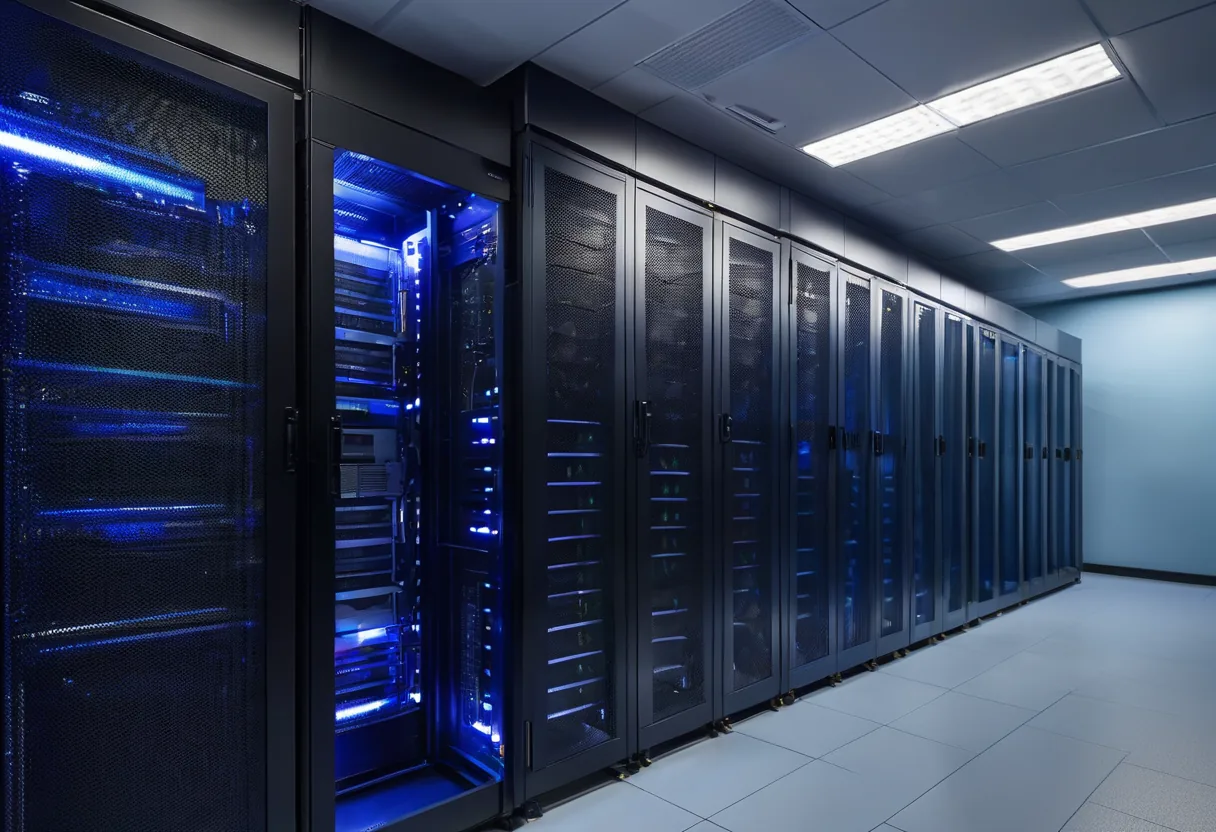
What we usually find on site
Plenty of servers live in a storeroom or under the accountant's desk: hot, dusty, unearthed, and open to the cleaner. The pattern we see again and again: the only air-conditioner fails in April, the room hits 40°C within the hour, and the switches and NAS shut themselves down. Sometimes the AC never comes back after a power cut because it has no auto-restart.
What a server room should have
| System | What we design |
|---|---|
| Racks & cabling | 42U racks, cable management, both-end labels, front-to-back airflow |
| Cooling | Two alternating (N+1) air-conditioners or precision cooling |
| Power | Online double-conversion UPS, dual PDUs, earthing, surge protection |
| Security | Card or face access, CCTV, an entry log |
| Fire | Smoke detection and clean-agent gas suppression |
| Monitoring | Temperature, humidity and water-leak sensors alerting via SMS/LINE/email |
Heat and unsteady power
Two air-conditioners on a lead/lag controller that alternates them and starts the second unit when temperature climbs. Both must restart by themselves after a power cut. Many Vientiane buildings see voltage sag between 17:00 and 19:00 as load peaks; an online double-conversion UPS keeps the output steady throughout. We measure earth resistance on site rather than trusting the drawings.
Things that get missed
- A gas-suppressed room has to be sealed, or the agent leaks out before the fire is out
- No condensate or building water pipes over the racks
- Mine-site rooms need dust filters and a cleaning schedule
Right-sized
From a single rack in an office to multi-rack rooms with raised floors or aisle containment.
Send us photos of the room and its dimensions on WhatsApp and we will tell you whether it can work and what needs to change.
What it does
Redundant cooling
N+1 air-conditioning with a lead/lag controller and auto-restart after outages.
Clean power
Online UPS, surge protection and a measured earth.
Cabling & labeling
Tidy cabling, labels at both ends and patch documentation.
Environmental sensors
Temperature, humidity, water and smoke alerts before equipment shuts down.
Physical access control
Card or face access with CCTV on every entry.
Fire suppression
Early smoke detection and equipment-safe gas suppression.
Design and rollout
- 1
Site survey: space, floor loading, power, earthing and flood or leak risk.
- 2
Calculate power (kW) and heat load (BTU/h) to size UPS and cooling.
- 3
Design rack layout, cable pathways and airflow.
- 4
Install power, cooling, racks, security and fire systems.
- 5
Cut the mains and switch off one AC for real, then hand over documentation.
Where it fits
- A head office moving into a new building in Vientiane.
- A dusty mine-site server room that needs sealing and filtration.
- Hotels and hospitals that run 24/7.
- School or ministry IT rooms being brought up to standard.
Typical system sizes
Micro
Fits: Single rack in an office
- Enclosed, locked rack with fans
- Online UPS and PDU
- Temperature sensor
Standard
Fits: 2–4 racks, dedicated room
- N+1 cooling with lead/lag controller
- Access control and CCTV
- Full sensor suite and alerting
Enterprise
Fits: 5+ racks or a small data hall
- Precision cooling and containment
- Modular UPS and gas suppression
- DCIM and MA contract
Brands we supply & install
All brand names and trademarks belong to their respective owners. Mention does not imply official partnership unless explicitly stated. Products are sourced through legitimate distribution channels.
FAQ
What temperature should a server room run at?
ASHRAE recommends equipment inlet air of about 18–27°C. There is no need to run the AC at 16°C; what matters is stability and a standby unit.
Can we use ordinary split air-conditioners?
For small rooms, yes: two units, a lead/lag controller and auto-restart after power returns. Comfort units are not designed for 24-hour duty, so they need more frequent cleaning and checks. Larger rooms should use precision cooling.
Why not water sprinklers in the server room?
Water ruins every device in the room, even for a small fire. Clean-agent gas puts the fire out without damage, but the room must be sealed and the design has to fit the building's fire protection. Where the building already has sprinklers throughout, a pre-action system is the usual compromise.
Related guides
Server Room Checklist for a Hot, Humid Climate: Power, Cooling, Security and Cabling
The checklist we actually use when building or fixing server rooms in Laos: brownouts, failed AC, flooding, dust, and the documentation nobody writes.
Sizing a UPS Properly: VA, Watts, Power Factor and Real Battery Runtime
Why some 3 kVA UPS units only deliver 1,800 W, how to choose between offline, line-interactive and online, how to estimate runtime realistically, and how to pair a UPS…
Network Rack Layout and Labeling: So the Next Technician Finds the Cable in Five Minutes
Sizing the rack, laying out equipment, managing cables and a TIA-606 style labeling scheme, plus a maintenance schedule and advice for dusty, hot sites.
Related solutions
Data Center & Servers
 Server VirtualizationCollapse a room of ageing servers into one cluster on VMware, Proxmox, Nutanix or Hyper-V, so one dead host no longer stops the…
 Hyperconverged Infrastructure (HCI)Compute, storage and virtualization in the same nodes; add a node when you need more. Built for 1–3 person IT teams with no SAN…
 NAS & SAN StorageCentral storage: NAS for shared files, SAN for VMs and databases, with RAID, snapshots and per-department permissions.
 Backup & Disaster Recovery3-2-1 backups with an immutable copy ransomware cannot delete, and restores that are actually tested, not just green job reports.
 UPS & Power ProtectionUPS, earthing and surge protection for servers, switches and CCTV. Built for outages, evening brownouts and rainy-season…
Send us a floor plan or a few photos of the site
We’ll come back with a few questions, then a first design. The first consultation is free, in Lao, Thai or English, on WhatsApp or our Facebook page.