Hotels & Hospitality
Guest Wi-Fi that doesn't end up in your reviews, plus CCTV, voice and backup power for hotels in Vientiane, Luang Prabang and Vang Vieng.
What makes this sector hard
- Guests book on reviews, and "bad Wi-Fi" is one of the most common complaints. It has to work in the bedroom and by the pool, not just the lobby.
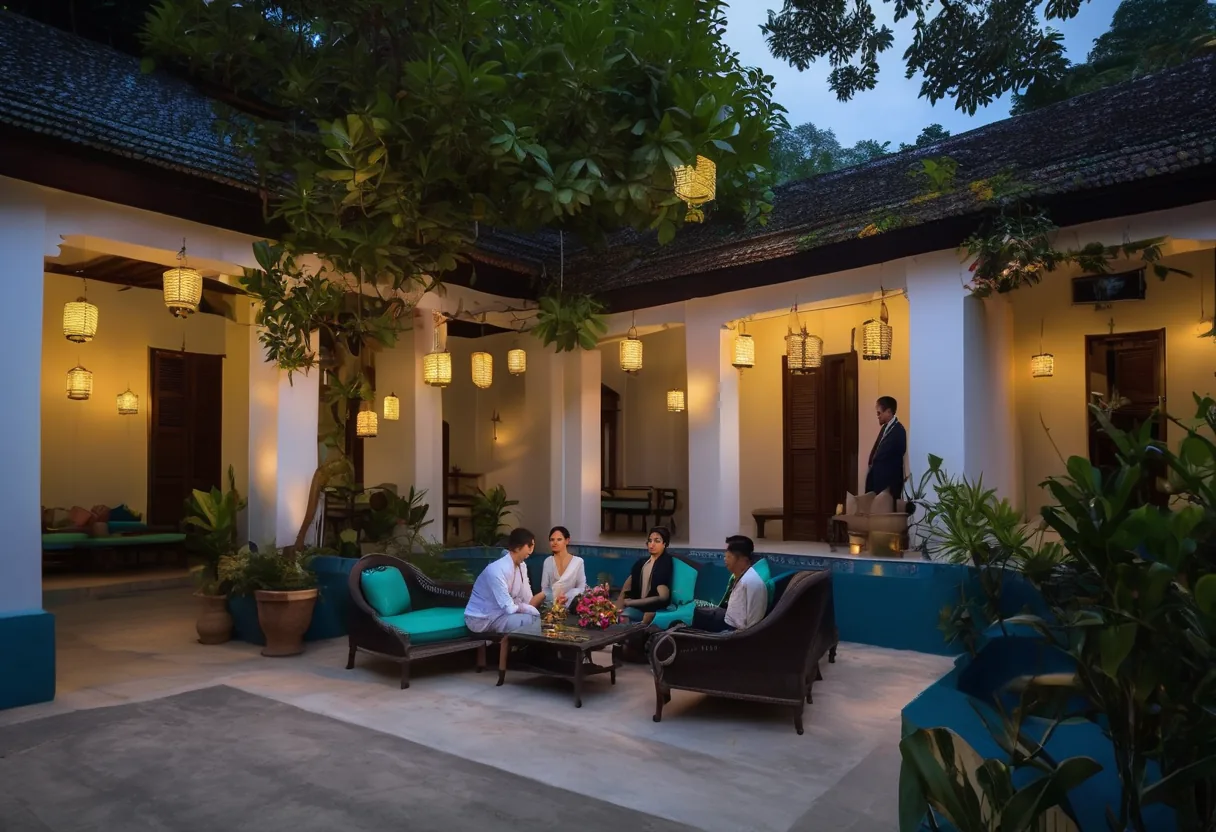
- Heritage buildings in Luang Prabang have thick walls, and owners often won't allow drilling or external fittings. Conventional cabling is usually out.
- PMS, POS and card terminals often sit on the same network as guest Wi-Fi, because that was the quickest original install.
- A power cut in high season during check-in means a queue at the front desk and unhappy guests.
- Out-of-town resorts have no IT staff. The person rebooting the router is usually the night receptionist.
Reference IT design
The most common hotel mistake we see is access points in the corridor, hoping the signal makes it through the bathroom door and a concrete wall to the bed. Usually it doesn't. Here's what we do instead.
Guest Wi-Fi
- Designed from a Wi-Fi site survey of the actual building. Typically one AP in-room or one per two rooms, depending on wall construction.
- Wall-plate APs mounted over existing data points work well in older and heritage buildings: no new cable, and they still give the TV a wired port.
- Outdoor APs for the pool and garden, mounted under eaves where possible to keep them out of direct sun and rain.
- Captive portal by room number or voucher, client isolation between guests, and WPA3 on the staff SSID.
- Cloud-managed Wi-Fi, so we see a failing AP before a guest does and can fix it from Vientiane.
- Per-guest bandwidth limits, so one guest uploading drone footage doesn't slow the whole floor.
Internet and power
- Fiber from two ISPs with load-balancing and failover. In Vang Vieng and at out-of-town resorts, the second path may be a point-to-point wireless link or 4G.
- UPS on network cabinets, PMS and the phone system, sized to carry them until the generator starts and stabilizes, typically 15–30 minutes.
Keep the important systems apart
- Separate VLANs for guests, staff, PMS/POS, cameras, IP phones and building IoT.
- A next-generation firewall controlling traffic between VLANs and filtering malicious sites.
- Endpoint protection on front-desk and finance PCs. Email security matters here: fake booking-site emails asking staff to "verify your account" are common.
Voice, sound and screens
- IP-PBX integrated with the PMS for wake-up calls and call billing.
- Public address for background music and emergency announcements; digital signage in the lobby and meeting rooms.
CCTV and access
- IP CCTV in the lobby, corridors, car park, kitchen and cash office. Never in private guest areas.
- Access control for the server room, stores and back-of-house; time attendance for staff.
- Network monitoring that alerts when an AP or uplink goes down.
Planning the work
Install in low season, one floor at a time, so sales can keep selling rooms. For heritage properties in Luang Prabang, agree with the owner exactly where drilling is allowed before running cable or fixing anything to the outside.
On a tight budget: dual internet and guest Wi-Fi first, then PMS/POS isolated behind the firewall, then UPS. CCTV, voice and PA can follow the renovation plan.
Send us one guest-floor plan on WhatsApp and we'll mark AP positions, with the reasoning.
Send us a floor plan or a few photos of the site
We’ll come back with a few questions, then a first design. The first consultation is free, in Lao, Thai or English, on WhatsApp or our Facebook page.