 Data Center & Servers
Generator & ATS Backup Power
Standby diesel generator with ATS for offices, clinics, hotels and remote sites, sized to work with your UPS.
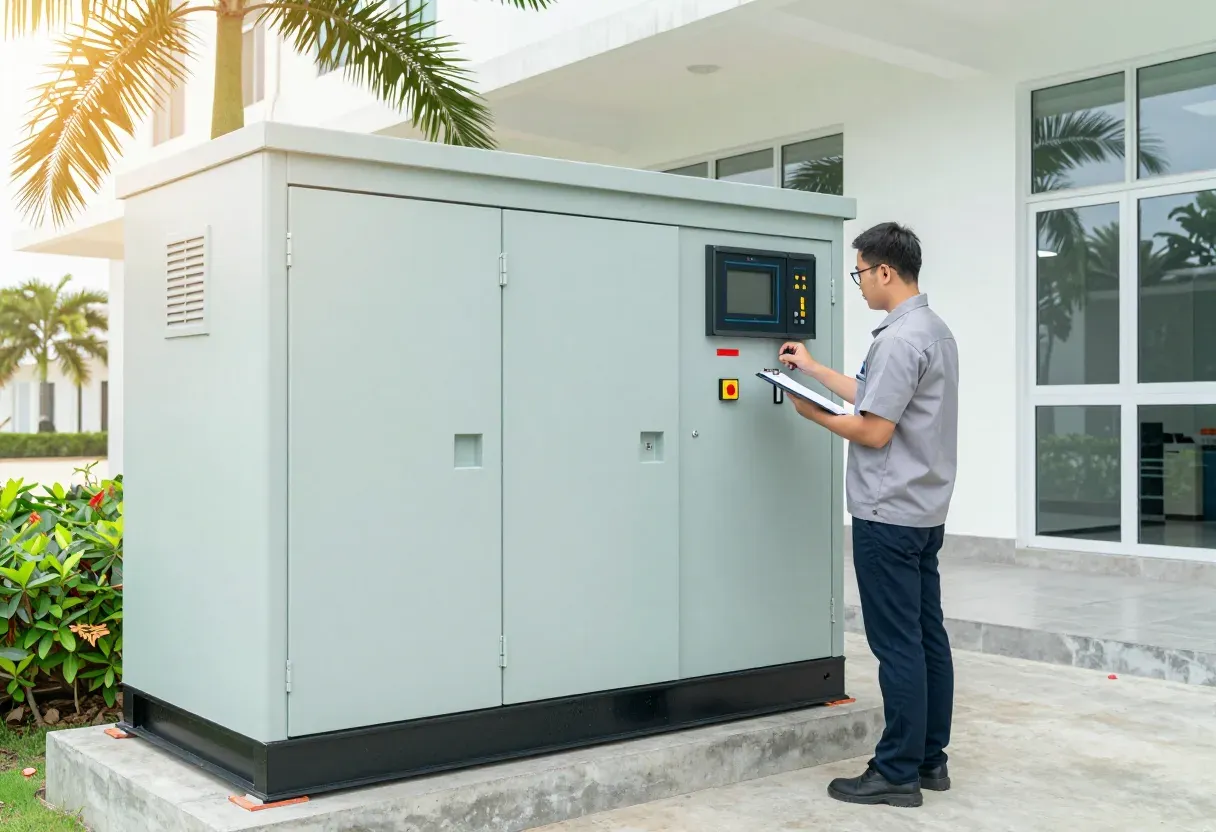
What we usually find on site
Evening brownouts between 17:00 and 19:00 plus rainy-season blackouts stop servers, CCTV and front-desk work in Laos. A UPS alone lasts minutes, while a generator that is undersized, never tested under load, or whose ATS was left in manual after service leaves the whole building dark despite the money spent.
Where the generator fits
A standby diesel generator does a different job from a UPS. The UPS bridges 10 to 30 seconds while the set starts, then the generator carries the site for hours. For most offices under 50 people we would back up the server rack, switches, CCTV recorder and a few lights only, because adding every air conditioner doubles the set size for little benefit. Remote sites often add a hybrid solar and battery system so the generator runs fewer hours per day.
Sizing and switching done properly
Sizing starts from a measured load list, not the main breaker rating. We record kW and power factor, convert to kVA, then add margin for motor starting current, which reaches 5 to 7 times running current on pumps and compressors. UPS input on a generator needs care: distorted UPS input current can force an oversize of about 1.5 to 2 times the UPS kVA, or the UPS may reject the supply when frequency drifts. The ATS sits between utility, generator and load:
- Open-transition ATS with adjustable delay, so voltage and frequency settle before loading
- Correct poles: 3-pole where the neutral stays common, 4-pole where it is switched and earthed once
- Monthly test under load, because an unloaded run hides fuel faults and flat starter batteries
Details that decide reliability
What we usually see on sites is small: a flat starter battery, an ATS left in manual after maintenance, or a set that never ran under load. We size cables for voltage drop, set one clean earthing point, route exhaust away from intakes, and ventilate for hot-season heat. Fuel planning counts too: a 40 kVA set at half load burns roughly 5 to 6 litres an hour, so a 100-litre tank lasts about 16 to 20 hours. Send us a photo of your main panel, your load list and the generator nameplate if one exists on WhatsApp and we will suggest a size and ATS arrangement.
What it does
Load survey and kVA sizing
Measured load list with motor-starting margin, matched to UPS input and real load.
ATS with adjustable transfer delay
Open-transition switching that waits for stable voltage and frequency before loading.
UPS-generator coordination
UPS settings widened for generator frequency drift so the UPS stays online.
Cabling, earthing and exhaust
Cable sizing for voltage drop, single earthing point, safe exhaust routing.
Fuel and runtime planning
Daily fuel use calculated with a refuelling routine for remote and rainy-season sites.
Monthly testing and remote alarms
Loaded test runs each month with outage and battery alarms to your phone.
Design and rollout
- 1
Survey the load: kW, power factor and the starting current of every motor.
- 2
Size the set and the ATS, including pole count and transfer delay.
- 3
Install the plinth, cabling, earthing, exhaust and ventilation.
- 4
Commission UPS coordination and test a full transfer of the building.
- 5
Hand over the monthly test routine and the oil, filter and battery schedule.
Where it fits
- Offices where evening brownouts restart PCs, routers and the PBX.
- Server rooms where the UPS covers minutes but outages last hours.
- Clinics and hotels keeping vaccine fridges, corridor lights and booking systems up.
- Mine camps and remote sites running the set for hours each day.
Typical system sizes
Office and clinic
Fits: Single building with one backup circuit, single-phase or small three-phase.
- Standby set with one ATS and a clearly separated backup circuit.
- Tested with your existing UPS plus a monthly test checklist.
- Staff training on oil, starter battery and ATS status checks.
Server room and hotel
Fits: Three-phase sites where servers, CCTV and guest services must stay up.
- Three-phase ATS with UPS coordination and remote outage alarms.
- Labelled backup and non-backup circuits at every panel.
- Maintenance plan for oil, filters, coolant and starter batteries.
Remote and mine site
Fits: Sites with long outages or no grid, running the set daily.
- Prime-rated set with reserve fuel storage and a refuelling plan.
- Hybrid solar and battery option to cut daily running hours.
- Dust protection, filter routines and on-site consumable spares.
FAQ
Do we still need a UPS with a generator?
Yes. The set needs 10 to 30 seconds to start, and the UPS covers that gap and shields servers from flicker.
Why does our UPS reject generator power?
Usually frequency drift or an undersized set. We widen UPS input windows and size the set with margin.
How often should we test the generator?
Monthly, under load, for 20 to 30 minutes, checking battery, fuel and ATS position.
Can solar cut our diesel use?
Yes. A hybrid solar and battery plant takes daytime load, leaving the set for nights and cloudy days.
Related guides
Power Cuts: Is a UPS Enough, or Do You Need a Generator?
Which outages a UPS can ride through, when you need a generator with ATS, and how to size both right.
Sizing a UPS Properly: VA, Watts, Power Factor and Real Battery Runtime
Why some 3 kVA UPS units only deliver 1,800 W, how to choose between offline, line-interactive and online, how to estimate runtime realistically, and how to pair a UPS…
Server Room Checklist for a Hot, Humid Climate: Power, Cooling, Security and Cabling
The checklist we actually use when building or fixing server rooms in Laos: brownouts, failed AC, flooding, dust, and the documentation nobody writes.
Generator, Battery or Hybrid Solar for Backup Power?
Generator, battery or hybrid solar? Compare switch-over, cost drivers and battery sizing for power cuts.
Related solutions
Data Center & Servers
 Server VirtualizationCollapse a room of ageing servers into one cluster on VMware, Proxmox, Nutanix or Hyper-V, so one dead host no longer stops the…
 Hyperconverged Infrastructure (HCI)Compute, storage and virtualization in the same nodes; add a node when you need more. Built for 1–3 person IT teams with no SAN…
 NAS & SAN StorageCentral storage: NAS for shared files, SAN for VMs and databases, with RAID, snapshots and per-department permissions.
 Backup & Disaster Recovery3-2-1 backups with an immutable copy ransomware cannot delete, and restores that are actually tested, not just green job reports.
 Server Room Build-outServer rooms built for the Lao climate: racks, N+1 cooling, online UPS, earthing, gas suppression, access control and alerting…
 UPS & Power ProtectionUPS, earthing and surge protection for servers, switches and CCTV. Built for outages, evening brownouts and rainy-season…
Send us a floor plan or a few photos of the site
We’ll come back with a few questions, then a first design. The first consultation is free, in Lao, Thai or English, on WhatsApp or our Facebook page.