 Networking
Point-to-Point Wireless Links
PtP/PtMP radio links over several kilometres for buildings and sites you can't cable, across roads and rivers.
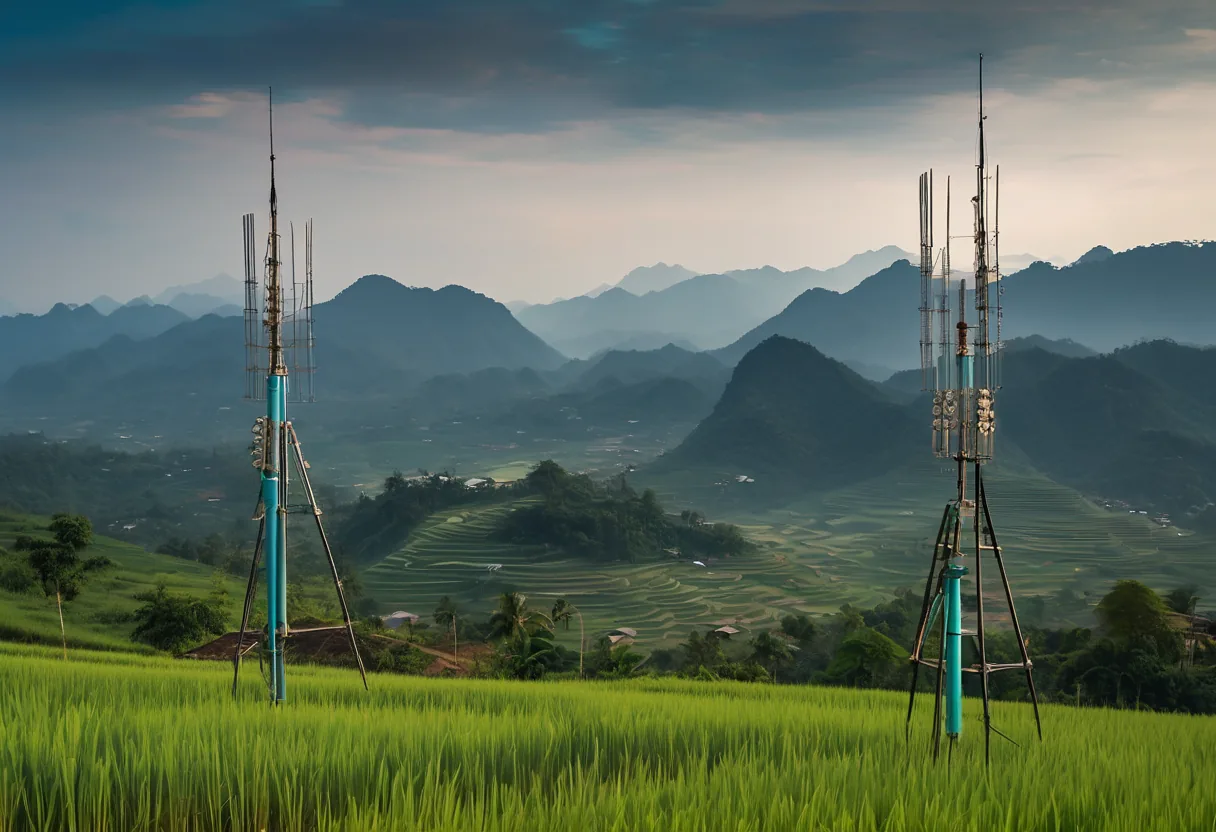
What we usually find on site
Construction sites, mines and warehouses away from the office often have no fiber nearby. Trenching across a road or river means several permits and months of waiting, for a site that may only exist for a year.
A point-to-point (PtP) link uses directional antennas to beam between two places that can see each other. Current 5 GHz radios deliver hundreds of Mbps up to gigabit-class over several kilometres. 60 GHz and E-band (70/80 GHz) give multi-gigabit throughput over shorter distances and fade in heavy rain.
Design before anyone climbs a mast
We work out the link budget, check the Fresnel zone for trees, hills and buildings, and add fade margin for rain. Something we learn on site: a tree that's clear in the dry season can be in full leaf across the path in the wet season, and it grows every year. We allow extra mast height for that.
One base, many remotes
Need to connect several guard posts, camera poles or weighbridges? A sector base station serves many subscriber radios (point-to-multipoint). Every point gets a surge protector, a properly bonded earth and AES encryption. In Laos, an ungrounded mast is the number-one reason radios die in the rainy season.
What it does
Several kilometres
Depends on mast height and line of sight.
Gigabit-class capacity
5 GHz, 60 GHz or E-band, picked by distance.
Link budget on paper first
Fresnel clearance and rain margin checked before ordering.
Point-to-multipoint
One base station, many remote sites.
Earthing and surge protection
Every mast, every cable coming down it.
AES encryption
Traffic over the air is encrypted.
Design and rollout
- 1
Check line of sight on terrain maps, then confirm on site
- 2
Work out link budget, band and antenna gain
- 3
Install masts, earthing and surge protection
- 4
Align antennas and tune
- 5
Throughput test and add to monitoring
Where it fits
- Mine office to weighbridges and perimeter cameras
- Temporary construction sites needing internet and CCTV
- Two buildings with a road or river between them
- A backup path for a fiber link
Typical system sizes
Single Link
Fits: Two points, up to about 5 km
- A pair of 5 GHz PtP radios
- Mounts, earthing and surge protection
- Alignment and throughput report
Multi-site
Fits: 1 base station + 2–15 remotes
- PtMP sector base station
- A subscriber radio per site
- Frequency plan
Carrier-grade
Fits: Links that can't drop, or long distances
- Dual links, or 60 GHz/E-band with 5 GHz fallback
- Masts and relay points where needed
- Monitoring and maintenance
Brands we supply & install
All brand names and trademarks belong to their respective owners. Mention does not imply official partnership unless explicitly stated. Products are sourced through legitimate distribution channels.
FAQ
Does rain affect the link?
5 GHz barely notices. 60 GHz and E-band fade badly in the kind of heavy rain Laos gets in the wet season, so we shorten the design distance or add a 5 GHz fallback.
Do both ends need line of sight?
Yes, and not just a straight line: most of the Fresnel zone must be clear. A hill or building in the way means adding a relay.
Is it secure?
Enterprise radios use AES and narrow beams that are hard to intercept. The bigger risk is the factory-default admin password. We change it and lock down remote management every time.
Related guides
Internet Redundancy with Dual ISPs: When the Fiber Gets Cut
Failover or load balancing, how to pick two providers that won't fail together, the equipment you need, and how to test failover so you know it really works.
Designing an Office Network: What to Decide Before You Buy Anything
The order of decisions an engineer follows when designing LAN, Wi-Fi, firewall and power for a 20–300 person office in Laos, with a checklist and a phased budget.
Hotel Wi-Fi Design Guide: From Guest Rooms to Ballrooms and Garden Villas
In-room AP placement, a captive portal tied to the PMS, keeping guests away from hotel systems, a worked bandwidth example, and what is specific to hotels in Laos.
Related solutions
Networking
 Structured CablingCat6/Cat6A and fiber, labeled at both ends, every link tested, drawings handed over. Cabling done right once lasts 15+ years.
 Enterprise LAN & SwitchingA core–access LAN with VLANs, redundant uplinks and enough PoE. One looped cable no longer takes down the whole building.
 Enterprise Wi-FiWi-Fi 6/6E/7 with APs placed from real measurements. Works in a full meeting room, holds calls while you walk, secured with WPA3.
 SD-WAN for BranchesProvincial branches run two internet links at once. If one fails, the other takes over within seconds, and everything is…
 Fiber Backbone & Campus LinksFiber between floors, buildings and sites at 10–100 Gbps. It doesn't conduct, so lightning can't ride it from one building to the…
 Industrial Networking (OT)Hardened switches that survive dust, heat and vibration, with ring redundancy and IT/OT separation for plants and mines.
Send us a floor plan or a few photos of the site
We’ll come back with a few questions, then a first design. The first consultation is free, in Lao, Thai or English, on WhatsApp or our Facebook page.