 Networking
Remote Site Internet: 4G/5G, Satellite, Microwave
Internet and office links for camps, construction sites, and rural branches where fiber does not reach.
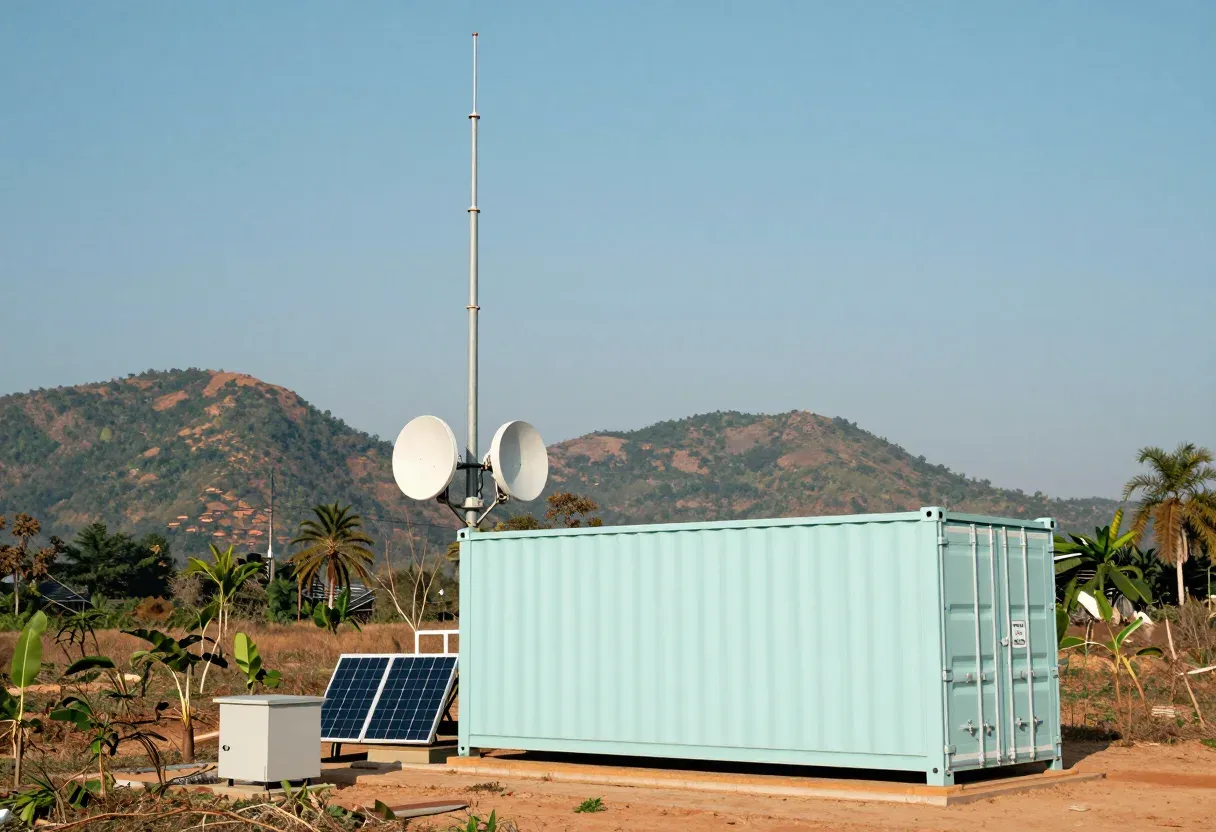
What we usually find on site
Remote camps and rural branches often run on a single indoor router with weak signal, so work stops when crews come online, evening brownouts reboot everything, and lightning kills unprotected masts. Email piles up, reports arrive late, and managers drive hours just to check figures. The site needs links that survive heat, dust, storms, and generator stops.
Why remote sites keep dropping offline
A camp or rural branch far from fiber usually depends on one indoor router with its small stock antennas. In weak-signal areas that stalls as soon as the crew comes online. What we usually see on sites in Laos adds more strain: 17:00–19:00 brownouts that reboot the router nightly, rainy-season lightning that kills unprotected masts, and dust and heat at mine camps that clog vents. The fix is not a stronger indoor box. It is an outdoor radio plan with clean power and a spare path.
What we install
For most sites under 50 people we start with a 4G/5G industrial router with external antennas, because mobile data costs less per gigabyte and handles calls better:
- Dual-SIM 4G/5G router with 9–14 dBi directional antennas on a 6–12 m mast, failing over in about 30–90 seconds.
- LEO satellite internet, only where the service is actually offered at that location, as primary or backup.
- GEO VSAT for email and reports, with round-trip latency around 600 ms, which suits store-and-forward work but not calls.
- Point-to-point microwave to the nearest fiber point for permanent camps, plus SD-WAN for branches to bond links or fail over between them.
Power, lightning, and upkeep
A radio on a mast is a lightning rod by shape, so every mast gets an air terminal, down conductor, earth rod, and surge protectors on antenna, power, and network lines. Power comes from the site supply with a small UPS for evening dips, or from solar with a battery bank sized for about 48 hours without sun. We survey signal and line of sight, install and align each path, drill the failover, then monitor remotely with scheduled visits. Send us your site GPS pin, a photo of the view toward the nearest town from the mast point, and a photo of the generator nameplate on WhatsApp, and we will reply with a link plan and a survey date.
What it does
Dual-SIM 4G/5G routers
Industrial router with two SIM slots and external high-gain antennas on a mast for weak-signal areas.
LEO satellite terminals
High-throughput satellite path where the service is offered at that location, as primary or backup.
GEO VSAT for basic traffic
Satellite backup for email and reports with about 600 ms latency, not suited to voice calls.
Point-to-point microwave
Fixed wireless link from the camp to the nearest fiber point for permanent high-traffic sites.
SD-WAN bonding and failover
One policy across all links so sessions survive when a single path drops or slows down.
Solar power and monitoring
Solar and battery for radio points plus remote monitoring with scheduled alignment and earthing checks.
Design and rollout
- 1
Survey the load and the signal: count users and devices, measure mobile signal on each network, and check line of sight to candidate relay points.
- 2
Design the link mix: pick primary and backup paths, mast height, antenna gain, band plan, and power budget for 48-hour autonomy at radio points.
- 3
Build power and earthing first: set the mast, earth rod, surge protectors, UPS or solar with battery, then prove the earth reading before radios go up.
- 4
Install and align the radios: mount, aim, and load-test each path, then drill automatic failover and record the results for handover.
- 5
Monitor and maintain on schedule: watch link health remotely, clean dust, recheck alignment and earthing, and restock spares before rainy season.
Where it fits
- Mine and quarry camps needing office links, shift reporting, and camera backhaul from pits far beyond fiber routes.
- Construction sites running site offices, plan sharing, and progress calls while the camp moves with the work front.
- Plantations and processing sheds sending harvest weights, stock counts, and machine logs to town each day.
- Rural branches and border checkpoints keeping POS, queues, and reporting online through brownouts and storms.
Typical system sizes
Single Remote Site
Fits: One camp, branch, or checkpoint that needs dependable internet with a backup path.
- Site survey with signal readings and a written link plan
- Mast, antennas, router, power, and lightning protection installed
- Failover drill with recorded results and staff handover
Multi-Site Operation
Fits: Several camps or branches reporting to one head office with central oversight.
- SD-WAN across sites with one monitoring view for all links
- Standard mast, power, and earthing kit repeated per site
- Scheduled visits for alignment, cleaning, and spare checks
Critical 24/7 Site
Fits: Sites where a night offline means lost production, safety gaps, or spoiled records.
- Three-path design with automatic bonding and failover
- Solar with battery autonomy plus on-site spare radio kit
- Priority remote response with quarterly earthing audits
Brands we supply & install
All brand names and trademarks belong to their respective owners. Mention does not imply official partnership unless explicitly stated. Products are sourced through legitimate distribution channels.
FAQ
Can we get satellite internet at our site?
Sometimes. LEO satellite service is only offered in some locations, and we check your GPS pin first. If it is not offered there, we design around 4G/5G with high-gain antennas, GEO VSAT for basic traffic, or microwave to the nearest fiber point.
Will video calls work over VSAT?
Not well. GEO VSAT round-trip latency sits around 600 ms, which callers feel as long pauses and talk-over. We keep VSAT for email, reporting, and messaging, and put calls on 4G/5G, LEO satellite, or microwave where possible.
How long does failover take?
Dual-SIM failover usually completes in about 30–90 seconds while the router registers on the second network. SD-WAN sessions can move faster because both paths stay up. We drill the failover at handover and record the times so staff know what to expect.
What happens when the generator stops at night?
The network should stay up. Radio points run on UPS through short dips and on solar with battery banks sized for about 48 hours without sun, so a generator stop affects lights and machines, not the link. We size the autonomy from your load during the survey.
Related guides
No Fiber? Internet Options for Rural Branches and Sites
No fiber at your rural branch? Compare 4G/5G antennas, LEO satellite, VSAT and microwave links, plus power and failover planning.
Internet Redundancy with Dual ISPs: When the Fiber Gets Cut
Failover or load balancing, how to pick two providers that won't fail together, the equipment you need, and how to test failover so you know it really works.
SD-WAN vs MPLS: Connecting Provincial Branches to Head Office
MPLS, traditional IPsec VPN and SD-WAN compared for organizations with branches across several provinces, the questions to ask vendors, and a migration order that keeps…
Related solutions
Networking
 Structured CablingCat6/Cat6A and fiber, labeled at both ends, every link tested, drawings handed over. Cabling done right once lasts 15+ years.
 Enterprise LAN & SwitchingA core–access LAN with VLANs, redundant uplinks and enough PoE. One looped cable no longer takes down the whole building.
 Enterprise Wi-FiWi-Fi 6/6E/7 with APs placed from real measurements. Works in a full meeting room, holds calls while you walk, secured with WPA3.
 SD-WAN for BranchesProvincial branches run two internet links at once. If one fails, the other takes over within seconds, and everything is…
 Fiber Backbone & Campus LinksFiber between floors, buildings and sites at 10–100 Gbps. It doesn't conduct, so lightning can't ride it from one building to the…
 Point-to-Point Wireless LinksPtP/PtMP radio links over several kilometres for buildings and sites you can't cable, across roads and rivers.
Send us a floor plan or a few photos of the site
We’ll come back with a few questions, then a first design. The first consultation is free, in Lao, Thai or English, on WhatsApp or our Facebook page.