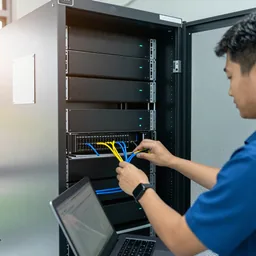
 AI for Organizations
AI Readiness & Pilot
We test AI on 20–50 of your own documents or recordings and show the results, mistakes included, before you buy a server.

What we usually find on site
Many organisations are told AI can read anything and answer any question. Then they buy a server and find it struggles with their scanned Lao documents, handwritten forms or meeting recordings. The sensible order is the other way round: test on your own material first, then decide.
Why test before you buy
AI quality depends heavily on the task and the language. A system that writes good English summaries may read a scanned Lao invoice poorly. So we do not start with a server quote. We start with your material.
How the pilot runs
- You choose 20–50 real samples: documents, forms, recordings or questions your staff ask every week. Include the hard ones.
- We agree in writing what "good enough" means for each task, for example which fields must be read correctly and which a person will still check.
- We run the samples on a test setup and return the results side by side with the originals. Every mistake stays visible.
- We say plainly where it is weak: handwriting, mixed Lao–Thai–English text, poor scans, regional accents, noisy rooms.
What you get at the end
A short report: which tasks are worth doing now, which are not ready yet, what server size the useful tasks need, and how staff would check the output. If the answer is "not yet", that is a good answer, because you have spent nothing on hardware.
Your samples are handled under the same rules as a live system. We agree first where they are kept, they are never used to train a public AI model, and they are deleted or returned when the pilot ends. What usually comes next is a private document assistant or speech-to-text for meetings.
What it does
Your own samples
20–50 real documents or recordings, hard ones included, not a tidy demo set.
Pass criteria agreed first
Written down before we start, so nobody argues about the result afterwards.
Side-by-side results
Every output sits next to its original. Mistakes are left in.
Lao measured, not assumed
The report shows, task by task, how Lao, Thai and English performed on your material.
An honest "not yet"
If a task is not ready, you hear it before you pay for any hardware.
Server sized from the results
The server is sized after the pilot, only for the tasks that passed.
Design and rollout
- 1
A WhatsApp chat or call: which work takes up staff time and what languages the documents are in.
- 2
You choose 20–50 real samples per task and may blank out names or details you prefer not to share.
- 3
Pass criteria and sample-handling rules written down before anything runs.
- 4
Run the pilot and lay results beside the originals, marking errors and low-confidence spots.
- 5
Review the results with the staff who actually do the work, because they know which mistakes are acceptable.
- 6
Report: recommended tasks, tasks not ready yet, server size and how output will be checked.
Where it fits
- For example, a procurement team that wants to know whether AI can really find clauses in old contracts.
- For example, an accounting team typing Lao and Thai invoices into Excel by hand every month.
- For example, a meeting secretary who wants to try transcribing Lao meetings.
- Offices with years of scanned files and no idea whether the scan quality is good enough.
- Managers who want real evidence before approving a hardware budget.
Typical system sizes
Single task
Fits: One department, one kind of document or recording
- Pass criteria written down first
- Side-by-side results for every sample
- Short report with a recommendation
Several tasks
Fits: 2–3 tasks, such as document search and data entry, in several languages
- Lao, Thai and English results compared per task
- A review session with the staff who do the work
- Server sizing for the tasks that passed
Organisation-wide
Fits: Several departments or branches that want one plan
- Readiness check of documents, network and server room
- A priority order of which tasks to do first
- Installation and staff-training plan
FAQ
Do we have to buy a server before the pilot?
No. The point of the pilot is that you see results first and decide afterwards. Server size is set once we know which tasks passed.
What if the Lao results are poor?
We tell you plainly and explain why. Sometimes it can be fixed with cleaner scans, typed forms instead of handwriting, or by starting with the Thai and English parts. For some tasks the right answer is to wait.
Which samples should we choose?
Pick the everyday ones and the hardest ones: blurry scans, handwriting, mixed-language pages. If you only send clean samples the result looks better than reality, and the problems arrive after go-live.
Will the live system match the pilot?
The same sample set becomes the acceptance test. We run it again before go-live and after every update, so you see at once if results change.
Related guides
How to Run an AI Pilot, Step by Step
A step-by-step pilot: pick one task, collect 20–50 real samples, write pass criteria in advance, run side by side with the current way, review mistakes with staff…
AI and the Lao Language: What to Test Before You Trust It
What to test before trusting AI with Lao: printed vs handwritten, scan/photo quality, mixed Lao-Thai-English, numbers/dates/names, tone marks and ໜ ໝ ຳ, speech with…
Private AI vs Cloud AI: How to Choose for Your Organisation
What changes between running AI on your own server and using a public cloud AI service — data sensitivity, internet dependence, control and upkeep — with a simple…
A Data Privacy Checklist Before You Put Company Documents Into Any AI
Before staff paste a contract, invoice or customer list into any AI tool, there is a sequence to check: classify the document, know where the AI runs, who holds an…
Using AI-Generated Images and Video in Marketing Honestly
AI images and video can help marketing when used honestly: label them as AI-generated, never present them as the real product, venue or result, get permission before any…
Related solutions
AI for Organizations
 Private AI Document AssistantA private assistant on your own server that searches your documents and answers in Lao, Thai or English, showing the file and…
 AI Speech-to-Text & Meeting NotesTranscribe meetings and recordings in Lao, Thai or English on your own server, then draft minutes for the secretary to check and…
 AI Document Data EntryAI reads forms, invoices and ID-style documents into your spreadsheet or system, and highlights uncertain fields for a staff…
 AI Content StudioAI-made images and short videos for marketing, every piece labelled as AI-generated and never presented as your real product or…
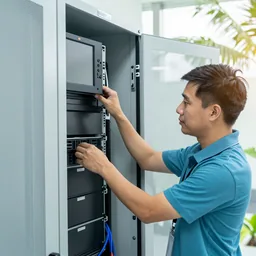 AI Server Setup & CareWe install the AI server in your building with user accounts, backup and an acceptance test, then look after it and re-test it…
 AI Staff TrainingHands-on workshops in Lao, Thai or English: safe everyday use of AI, writing prompts, checking the output and rules for data.
Send us a floor plan or a few photos of the site
We’ll come back with a few questions, then a first design. The first consultation is free, in Lao, Thai or English, on WhatsApp or our Facebook page.