Juniper Networks
Juniper made its name with MX routers in service-provider networks and SRX firewalls. On the enterprise side, Juniper Mist uses its Marvis AI to pinpoint why a user can't connect. Since July 2025 Juniper has been part of HPE, in the HPE Networking unit alongside Aruba.
- Headquarters
- United States
- Positioning
- Mid-marketEnterprise
- Official website
- www.juniper.net
Who it suits
ISPs, data center operators and organizations running BGP with several upstreams, or wanting Wi-Fi that can be troubleshot from a dashboard.
Overview
Juniper today
Juniper Networks was founded in California and made its name with routers in service-provider networks. Since 2 July 2025 it has been part of Hewlett Packard Enterprise (HPE), inside the HPE Networking unit alongside Aruba. HPE has said Juniper Mist and Aruba Central will remain two separate platforms that share AI features. HPE documentation now often calls the cloud HPE Mist.
How the product families fit together
- MX Series routers serve ISPs, telecom operators and BGP edges with several upstreams.
- EX Series switches cover the campus. The EX4100 and EX4000 handle access, and the EX4400 handles heavier access and aggregation.
- QFX Series switches cover the data center, often paired with Apstra to build and check the fabric automatically.
- SRX Series firewalls: the SRX300 line for branches, and the SRX1600, SRX2300 and SRX4300 for head offices and high-traffic sites. SRX also acts as the SD-WAN gateway.
- Juniper Mist is the cloud that manages APs, EX switches and SRX. Subscriptions are split by job: Wi-Fi Assurance, Wired Assurance, WAN Assurance and Access Assurance (cloud NAC).
- Marvis is the AI assistant inside Mist. You can ask in plain language, for example "why does this user's Zoom call keep breaking up", and it points to the AP, switch or WAN link at fault.
Operating system and licensing
EX, QFX, MX and SRX all run Junos, so one skill set covers every line. Engineers like that config changes do nothing until you commit them, and a bad change can be rolled back at once. Mist is sold as a per-device subscription, while Access Assurance is priced on the number of concurrently connected clients.
Juniper fits ISPs, data center operators and organizations running BGP with several providers. On the enterprise side it suits small IT teams looking after many branches who want Mist to point at the problem instead of guessing.
Strengths
- One Junos runs on switches, routers and firewalls, and its commit and rollback model lowers the risk of changing config on a live network.
- Marvis in Mist looks at Wi-Fi, switch and WAN data together to find why a user can't connect or is slow. An IT team in Vientiane can check provincial branches without travelling.
- MX routers and QFX switches are well proven in ISP and data center networks for large BGP tables and continuous operation.
- Being part of HPE lowers the vendor-stability risk and brings HPE's service network in the region.
Things to know before choosing
- Mist is cloud-only and needs a per-device subscription. If your policy keeps management data inside the organization, discuss that before choosing it.
- Engineers who know Junos are much scarcer in Laos than Cisco engineers, and most work for ISPs. A typical organization should have a support contract with a team that knows Junos.
- HPE now owns both EX and Aruba CX switches. Overlapping lines may be reshaped over time, so ask for the roadmap of the models you buy.
- Spares and RMA go through distributors in Thailand. MX routers and line cards are rarely stocked, so critical systems need an advance-replacement contract or a spare on site.
Using it in Laos
In Laos, Juniper is most often found at ISPs, telecom operators and data centers in Vientiane, which use MX and QFX for BGP and international links. It is still uncommon in ordinary organizations, but Mist is getting attention from companies with many branches.
What to know on site:
- Internet: Mist APs keep serving clients when the cloud can't be reached, but you can't see or change anything until the link is back. Provincial branches with a single line should have a 4G backup.
- Power: routers and core switches should have two power supplies on two separate UPS feeds. Rainy-season lightning is the failure cause we see most.
- Ordering: through distributors in Thailand. Larger models are usually built to order and take several weeks.
- People: Junos skills are scarce. Keep configs and network diagrams fully documented so you don't depend on one person.
Sectors that fit: ISPs, data centers, banks running BGP, and companies with many provincial branches.
Compared with alternatives
HPE Aruba has the same parent and is the better fit when you need ClearPass and detailed NAC. Cisco suits you if easy hiring matters, since most engineers learned on CCNA. MikroTik is the option for small ISPs or branches that need routing on a tight budget. Pick Juniper when BGP and routing stability matter most, or when you want Mist to help troubleshoot many branches.
Product lines
- EX Series
- QFX Series
- MX Series
- SRX Series
- Juniper Mist
- Marvis
Solutions that use this brand
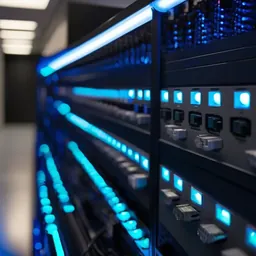 Enterprise LAN & SwitchingA core–access LAN with VLANs, redundant uplinks and enough PoE. One looped cable no longer takes down the whole building.
 Enterprise Wi-FiWi-Fi 6/6E/7 with APs placed from real measurements. Works in a full meeting room, holds calls while you walk, secured with WPA3.
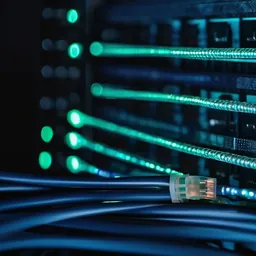 Fiber Backbone & Campus LinksFiber between floors, buildings and sites at 10–100 Gbps. It doesn't conduct, so lightning can't ride it from one building to the…
 SD-WAN for BranchesProvincial branches run two internet links at once. If one fails, the other takes over within seconds, and everything is…
 Next-Generation Firewall (NGFW)A firewall that knows which app and which user, with IPS, web filtering, HTTPS inspection and VPN, sized on real all-features-on…
 Network Monitoring (NMS)Every device, link and internet circuit on one screen, with alerts that reach IT before the first user calls.
 Zero Trust & Network Access Control (NAC)Check every user and device before it joins, with 802.1X and NAC. Plugging into a LAN port no longer means reaching the servers.
FAQ
Now that HPE owns Juniper, will the Juniper lines be discontinued?
HPE has said it will keep both Mist and Aruba Central, and the MX, QFX and SRX lines are still sold. What may change over time is where lines overlap. Check the end-of-sale status of the models you buy and ask for the roadmap before signing a long contract.
If the internet drops and Mist cloud is unreachable, does the Wi-Fi stop?
No. The APs keep their current config and keep serving users. You lose visibility, config changes and cloud-dependent features such as authentication through Access Assurance. If you use cloud NAC, have a backup internet line.
Do EX switches always need Mist?
No. EX switches can be configured through the Junos CLI or the on-box web interface. Mist Wired Assurance is an add-on subscription that brings monitoring and Marvis. A single office with a few switches often doesn't need it.
Our team learned on CCNA. Will Junos be hard for them?
VLAN, OSPF and BGP concepts are the same, but the syntax is hierarchical and changes must be committed. Most Cisco-trained engineers settle in within a few weeks. The commit confirmed command, which rolls a change back unless you confirm it, stops you locking yourself out of a remote device.
All brand names and trademarks belong to their respective owners. Mention does not imply official partnership unless explicitly stated. Products are sourced through legitimate distribution channels.
Send us a floor plan or a few photos of the site
We’ll come back with a few questions, then a first design. The first consultation is free, in Lao, Thai or English, on WhatsApp or our Facebook page.