 光伏与能源
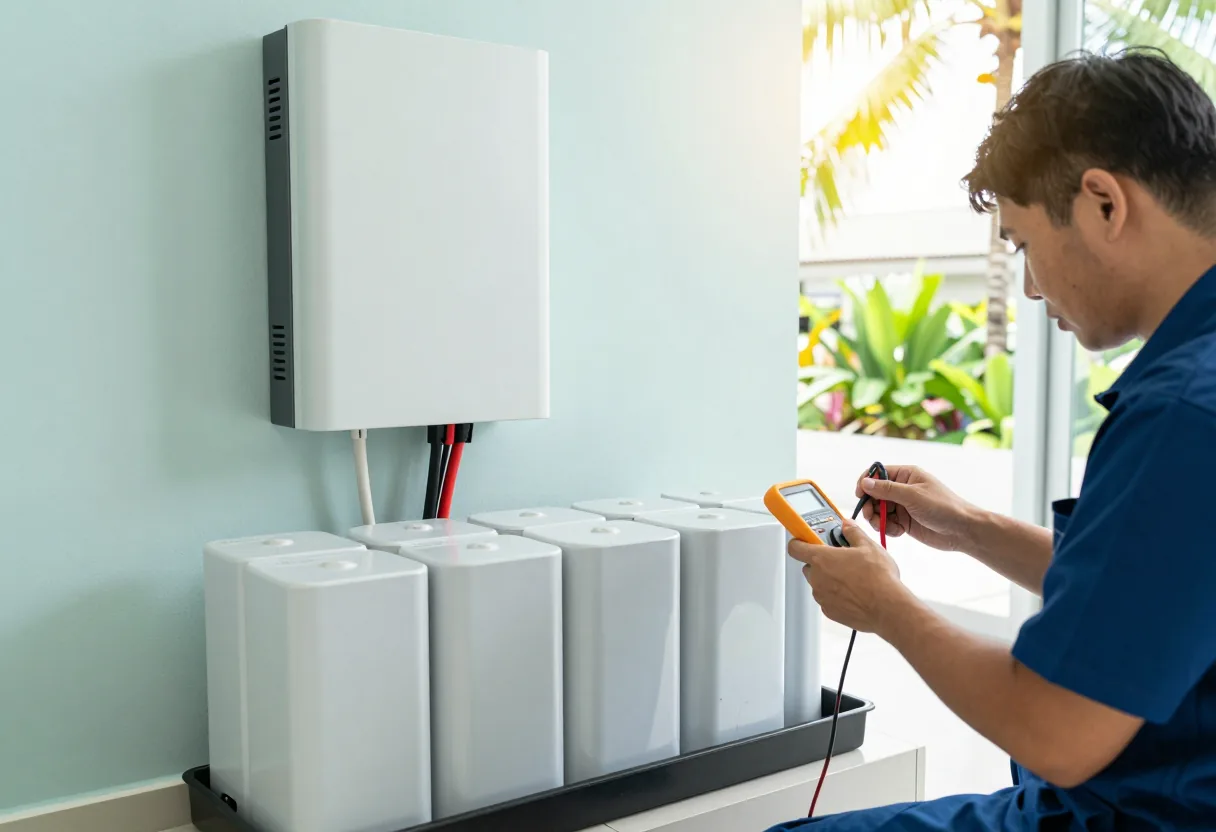
现场常见问题
In many towns the power dips or cuts out between 17:00 and 20:00 when every house switches on its air conditioning, and in the rainy season falling trees take lines down. Fridges, the shop's point-of-sale, Wi-Fi and CCTV all go dark. A generator is noisy and needs someone to start it. A plain on-grid solar system does not help either, because it shuts down when the grid does.
How hybrid differs from on-grid
A hybrid inverter connects to panels, a battery and the grid at the same time, and has a separate backup (EPS) output for essential loads. When the grid fails, it disconnects from the grid and keeps that output running from the battery and panels. Many models switch over in roughly 10–20 ms, so computers stay on. Some are slower, so if you have sensitive equipment we check the datasheet before we quote.
Choose the essential loads first, then the battery
The mistake we see most is putting the whole house or office on the backup side. Three air conditioners and a water pump will empty a battery in a couple of hours. We split out an essential-loads board: lighting, fridges, router, CCTV, computers and perhaps one air conditioner.
A simple way to think about it: 1.5 kW of essential load for 4 hours is 6 kWh. LiFePO4 lets you use about 90% of its capacity and you want some margin for cloudy days, so choose roughly 8–10 kWh. To run through the night or ride out multi-day outages you need more battery and more panels, or a generator wired into an inverter that supports one.
Why LiFePO4
| LiFePO4 | Lead-acid | |
|---|---|---|
| Usable share of capacity | About 90% | About 50% if you want it to last |
| Cycle life | Several thousand cycles | A few hundred to just over a thousand |
| Heat | Tolerates it better, still wants a cool spot | Life drops fast in a hot room |
| BMS talks to the inverter | Yes (CAN/RS485) | No |
What matters most is that the battery and inverter appear on each other's compatibility list, so the BMS can talk to the inverter and the warranty stays valid.
Read the battery warranty properly
Most LiFePO4 warranties have three limits: years, cycles or total energy throughput (MWh), and a minimum remaining capacity at the end. Whichever is reached first ends the warranty. We explain the terms for the model we propose, in writing.
Tell us what must stay on during an outage and for how long, and we will size the battery and panels. For server rooms, read UPS and power protection alongside this page.
功能
Essential-loads board
Circuits that must stay on are split from heavy loads so the battery lasts.
LiFePO4 with BMS
48 V or high-voltage batteries that talk to the inverter, with room to add modules later.
Rides through evening brownouts
When grid voltage leaves the safe window the inverter moves to battery, so air conditioners and fridges are not run on low voltage.
Generator input
Some inverters have a generator port for multi-day outages or cloudy rainy-season weeks.
Operating modes set for you
Keep the battery for backup, or use it in the evening while holding a reserve for outages.
A proper battery location
Shaded, ventilated, out of the sun and away from flammables. Heat shortens battery life.
设计与实施
- 1
Agree which loads must run in an outage, for how long, and how often outages happen in your area.
- 2
Measure essential loads and size battery kWh, inverter kW and array kWp.
- 3
Pick a battery and inverter that are on the makers' compatibility lists.
- 4
Install and split the essential-loads board, battery fusing and breaker, SPDs and earthing.
- 5
Test by actually cutting the grid supply and timing the switchover.
- 6
Set up monitoring and battery alarms, and explain the operating modes.
适用场景
- Shops and restaurants keeping point-of-sale, chillers and Wi-Fi on during evening outages.
- Health centres and clinics with medicine and vaccine fridges.
- Provincial hotels and guesthouses keeping corridor lights, water pumps and booking systems running.
- Offices with a small server, CCTV and accounting systems.
- Homes with frequent rainy-season outages.
常见系统规模
Home & Shop
适用于: Essential load up to about 3 kW, outages of a few hours
- Single-phase hybrid inverter, about 5–8 kW
- 48 V LiFePO4 battery, about 5–15 kWh
- Essential-loads board and monitoring app
Office & Clinic
适用于: Three-phase supply, essential load about 5–15 kW
- Three-phase hybrid inverter with high-voltage battery
- Live outage test with switchover timing
- Integration with the existing server UPS
Building & Hotel
适用于: Essential load above 15 kW, or several buildings
- Paralleled hybrid inverters or a building-scale battery system
- Generator and ATS integration
- O&M plan with yearly battery checks
我们供货并安装的品牌










所有品牌名称和商标归其各自所有者所有。除非另有明确说明,提及某品牌并不代表与其存在合作关系。产品均通过正规分销渠道采购。
常见问题
How long does a LiFePO4 battery last?
A good battery handles several thousand cycles, and most makers warrant around 10 years with a cycle or MWh limit. Real life depends on heat and use: a battery kept somewhere cool and not drained flat every night lasts longer.
Can a hybrid system replace a UPS?
For lights, fridges and ordinary computers, usually yes. For servers and equipment that must see zero transfer time, we still recommend an online UPS in front of them, with the hybrid system extending the backup time.
We already have on-grid solar. Can we add a battery?
Two ways. If the existing inverter is battery-ready, we add a compatible battery. If not, we install a separate battery inverter alongside it (AC-coupled). We check the model and firmware before quoting.
Is a lithium battery safe inside the house?
LiFePO4 has a lower fire risk than other lithium chemistries, but it still has to be installed right: correctly rated DC fuses and breakers, cable of the right size, terminals torqued to spec, and a cool, ventilated spot. Loose terminals are the most common cause of overheating we find.
相关指南
光伏用 LiFePO4 电池:DoD、循环次数、BMS、高温与容量选型
LiFePO4 为何已取代大部分铅酸电池,如何解读 DoD、循环寿命和质保,BMS 的作用,老挝高温为何重要,以及按备电时长确定电池容量。
并网、混合还是离网光伏:哪种适合您的站点?
三种光伏系统在电网停电时的表现、各自的现场条件要求,以及老挝的办公室、工厂、学校或偏远营地如何选择。
光伏逆变器类型:组串式、混合、微型、工商业与离网对比
各类逆变器的工作原理与适用场景,如何设定直流/交流容配比并匹配组串,以及在监控 App 中关注哪些数据以便及早发现问题。
正确选型 UPS:VA、瓦数、功率因数与真实电池续航
为什么有些 3 kVA UPS 只能带 1,800 W,后备式、在线互动式与在线式如何选择,如何实事求是估算续航,以及 UPS 如何与发电机配合。
如何选择光伏安装商:买家检查清单
一份好的光伏报价和安装应包含:现场勘察、明确品牌型号、组串设计、调试测试、质保条款,以及危险信号。
学校与公共建筑光伏:设计、安全与维护
学校和办公楼白天用电,正是光伏发电的时候。如何按负荷选型,选择防逆流并网、混合或偏远学校离网,保障学生安全,便于员工维护,并编写可公平比较报价的技术规格。
相关计算工具

相关解决方案
光伏与能源

发给我们建筑平面图或几张现场照片
我们会先询问一些细节,再给出初步设计方案。首次咨询免费,可用老挝语、泰语或英语,通过 WhatsApp 或 Facebook 主页联系。