 光伏与能源
现场常见问题
Many villages and work sites in the hills still have no power line, or a supply so weak that a fridge will not run. Generator fuel has to be hauled a long way, the sets are noisy and break down. Small do-it-yourself solar kits often work only in the dry season, and the battery dies within a year, because they were sized for sunny days rather than for the wettest month.
Designed for the darkest month
An off-grid system has no grid to fall back on. Every kWh you use must come from the panels and the battery. So we design for the month with the least sun in the rainy season, not the yearly average (about 4.5–5.5 kWh/m²/day), and give the battery days of autonomy for runs of overcast days.
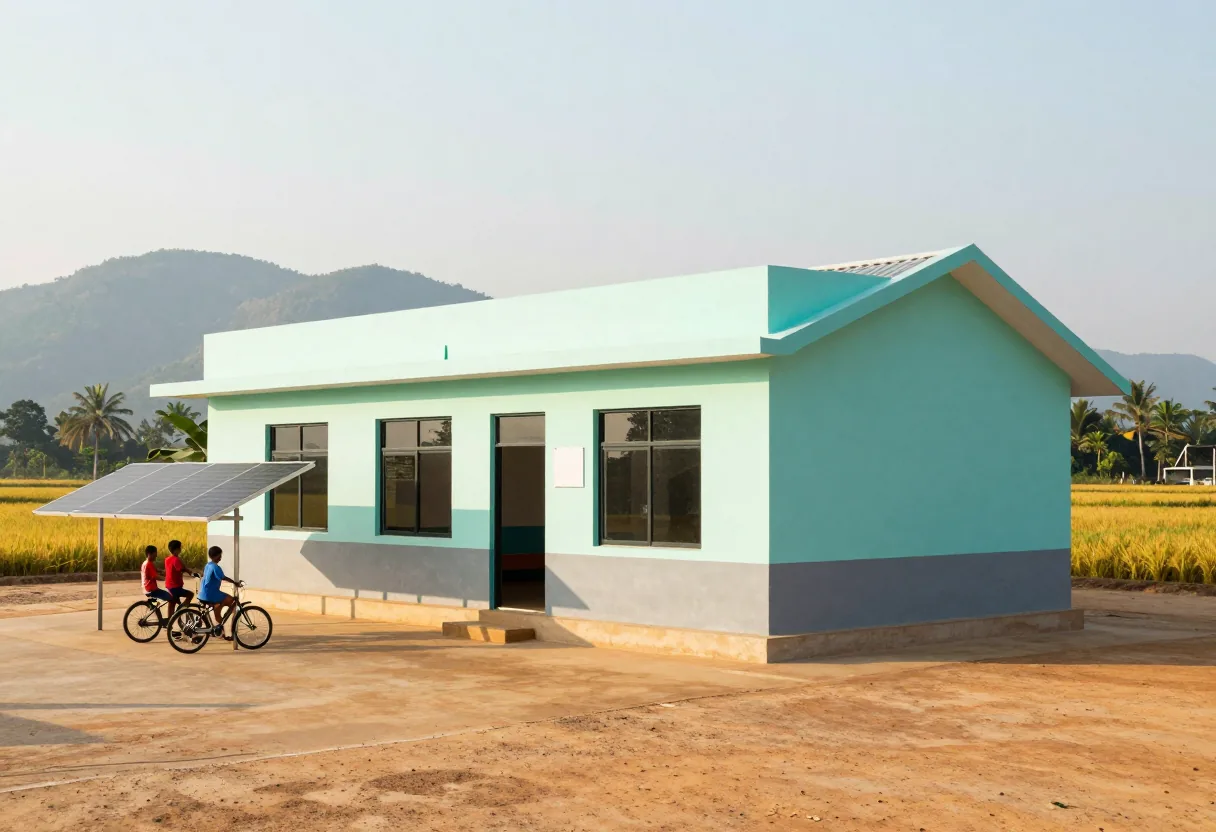
Worked example: a provincial primary school
| Equipment | Use | Energy/day |
|---|---|---|
| 10 LED lights × 10 W | 6 hours | 0.6 kWh |
| 5 computers/laptops × 60 W | 6 hours | 1.8 kWh |
| 6 fans × 50 W | 6 hours | 1.8 kWh |
| Projector 250 W | 3 hours | 0.75 kWh |
| Total | about 5 kWh |
If the worst month gives about 3.5 peak sun hours and system losses are about 25%, the array needed is 5 ÷ (3.5 × 0.75) ≈ 1.9 kWp. We would fit about 2.4 kWp (four 600 W panels). Battery for two days of autonomy: 5 × 2 ÷ 0.9 ≈ 11 kWh of LiFePO4. This shows the method; every site needs its real load measured.
Cut the load before adding panels
Off-grid, every watt counts. Switching to LED lighting, inverter air conditioners or efficient fridges, and keeping electric cookers and kettles off the system, makes it much smaller. We will tell you plainly which appliances do not belong on it.
Built to survive a remote site
- An inverter-charger with a generator input for weeks when the rain does not stop
- Lightning protection and good earthing, since remote sites are often high and exposed
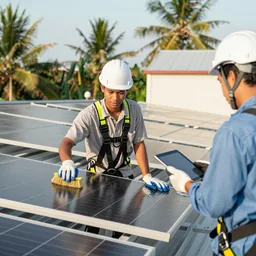
- Weatherproof, rodent- and insect-proof enclosures, and anti-theft bolts on the panels
- Remote monitoring over 4G where there is signal, so we see the battery before it runs flat
- Training for a local caretaker to clean panels and read the basic status lights
Tell us which province the site is in, how you get there and what will run on it. We will size the system and plan the transport.
功能
Sized for the rainy season
Uses the sun of the weakest month, with days of autonomy in the battery.
Off-grid inverter-charger
Clean sine-wave output, built-in MPPT and a generator input.
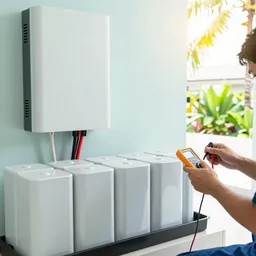
LiFePO4 storage
Many times the cycle life of lead-acid, and no topping up with distilled water.
Lightning and earthing
SPDs on every port and a measured earth, critical on hilltop sites.
Remote monitoring
Battery state and alarms over 4G where coverage allows.
Local caretaker training
An illustrated Lao-language guide: cleaning, reading status lights, what not to plug in.
设计与实施
- 1
List appliances and hours of use, then turn them into kWh per day.
- 2
Remove unnecessary loads and replace power-hungry appliances.
- 3
Size the array for the worst month, the battery for autonomy, and the inverter for peak load including motor start-up surges.
- 4
Pre-assemble and bench-test before shipping, and plan transport around the rainy season.
- 5
Install mounting, panels, equipment enclosure, earthing and lightning protection, then test every string.
- 6
Train the caretaker and switch on remote monitoring.
适用场景
- Primary and secondary schools in remote districts: lights, fans and a computer room.
- Health posts: delivery-room lighting, vaccine fridges and phone charging.
- Mining and construction camps cutting generator run-hours.
- Farms and plantations far from the line: lighting, CCTV and electric fencing.
- Telecom repeaters and village Wi-Fi points.
常见系统规模
Small Site
适用于: About 1–5 kWh/day: health posts, telecom points, remote homes
- 48 V inverter-charger with LiFePO4 battery
- Weatherproof, rodent-proof enclosure
- Lao-language caretaker guide
School & Farm
适用于: About 5–20 kWh/day: schools, farms, lodges
- Inverter sized for peak load, with generator input
- Two days of battery autonomy
- Remote monitoring where there is signal
Camp & Microgrid
适用于: Over 20 kWh/day, or several buildings sharing a generator
- Paralleled three-phase inverters
- Automatic generator start based on battery state
- O&M plan with on-site spares
我们供货并安装的品牌








所有品牌名称和商标归其各自所有者所有。除非另有明确说明,提及某品牌并不代表与其存在合作关系。产品均通过正规分销渠道采购。
常见问题
Can an off-grid system run air conditioning?
Yes, but the system gets much bigger. A 12,000 BTU inverter air conditioner draws about 0.8–1.2 kW; eight hours is roughly 6–9 kWh a day, more than the whole school in our example. We usually advise running it only in the middle of sunny days.
Do we still need a generator?
For critical sites such as health posts and work camps, we recommend one. Designing to get through every rainy week with no generator means far more panels and battery than is sensible. A small generator that runs a few times a year is the more reasonable answer.
Who fixes it if it breaks somewhere remote?
Remote monitoring lets us see the problem and guide the caretaker over WhatsApp first; many issues are settings or dirty panels. If a visit is needed, we schedule it and bring the parts the diagnosis points to.
相关指南
并网、混合还是离网光伏:哪种适合您的站点?
三种光伏系统在电网停电时的表现、各自的现场条件要求,以及老挝的办公室、工厂、学校或偏远营地如何选择。
光伏系统选型:从电费单 kWh 到 kWp、电池和逆变器
如何根据月度电费和白天负荷确定组件、电池和逆变器容量,附三个示例:并网办公室、混合住宅和离网卫生站。
光伏用 LiFePO4 电池:DoD、循环次数、BMS、高温与容量选型
LiFePO4 为何已取代大部分铅酸电池,如何解读 DoD、循环寿命和质保,BMS 的作用,老挝高温为何重要,以及按备电时长确定电池容量。
学校与公共建筑光伏:设计、安全与维护
学校和办公楼白天用电,正是光伏发电的时候。如何按负荷选型,选择防逆流并网、混合或偏远学校离网,保障学生安全,便于员工维护,并编写可公平比较报价的技术规格。
光伏逆变器类型:组串式、混合、微型、工商业与离网对比
各类逆变器的工作原理与适用场景,如何设定直流/交流容配比并匹配组串,以及在监控 App 中关注哪些数据以便及早发现问题。
备用电源选发电机、电池还是光储混合?
发电机、电池还是光储混合?对比切换方式、成本因素以及停电备电的电池容量选型。
相关计算工具
相关解决方案
光伏与能源
发给我们建筑平面图或几张现场照片
我们会先询问一些细节,再给出初步设计方案。首次咨询免费,可用老挝语、泰语或英语,通过 WhatsApp 或 Facebook 主页联系。