 Cybersecurity
DDoS & Web Application Firewall (WAF)
WAF and DDoS protection for Lao websites, booking pages, APIs and VPN portals, tuned and monitored.
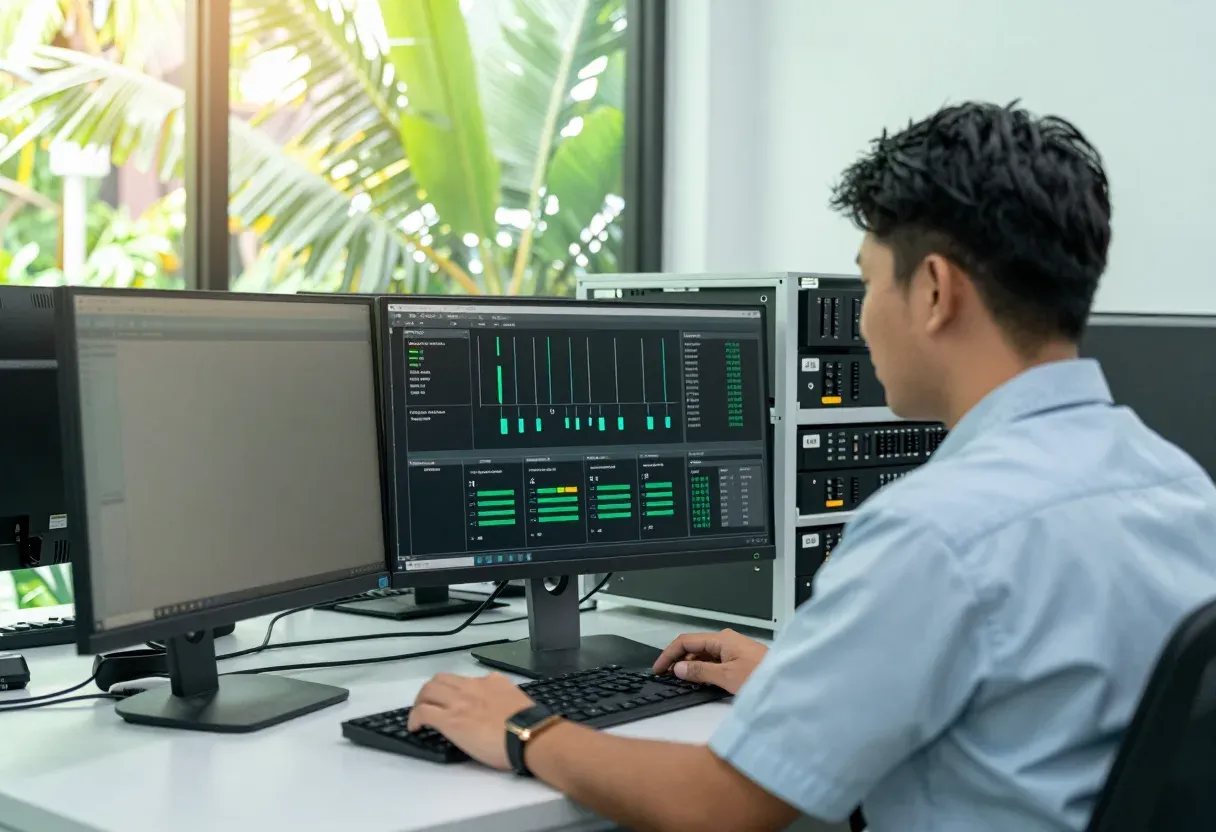
What we usually find on site
Many Lao business sites sit behind a single ISP link with the web server exposed directly on a public IP. CMS plugins go unpatched for months, login pages face automated password guessing all day, and one cheap booter attack takes the whole site offline and stops bookings and sales cold.
Why small sites go offline
Most Lao business sites we see sit behind one ISP link with the web server on a public IP. On a quiet day that works. When a cheap booter floods the link, the pipe fills before any on-prem box can react. Old plugins, open admin paths and direct-to-origin traffic give bots an easy way in, and one weak form can deface the homepage.
What we put in front of your site
For most offices with one or two sites we use a cloud scrubbing and reverse-proxy layer in front, with the existing firewall as the second layer. Floods are absorbed upstream instead of filling the office link. Our firewall work at the origin allows only proxy addresses. The WAF then checks requests for attack patterns, bad bots and login abuse.
- WAF rules for common web attacks, plus virtual patching while a plugin waits for update.
- Bot scoring, challenge pages and login protection that slows credential stuffing.
- Per-URL rate limits for search, forms and login pages.
- TLS with HTTPS redirect, and an origin locked to accept only proxy traffic.
- Alerts into monitoring so floods reach an engineer, not an unread inbox.
Tuning without blocking real visitors
Strict rules block real visitors, so we start log-only for a few days, allowlist payments and booking engines, then switch blocking on. For most shops under 50 staff we keep two login policies: staff portals get strict limits, public logins get slower limits with challenges, because staff can retry while guests simply leave.
What happens during an attack
When sensors trip, traffic shifts to scrubbing, suspects face challenges, and the origin stays reachable through the proxy. Afterward you get a short report: what arrived, what was blocked, and what to adjust. Send us your domain name and a screenshot of the last outage message on WhatsApp, and we will say where protection should sit.
What it does
Managed WAF rules
Blocks common web attacks like SQL injection and XSS, with temporary cover for old plugins.
Bot and credential-stuffing control
Separates good bots from bad ones, slowing password guessing on logins and APIs.
Per-URL rate limiting
Caps hits on search, forms and logins, such as slowing logins after 5 failures in 10 minutes.
Cloud DDoS absorption
Absorbs flood traffic upstream so it never fills the single office ISP link.
Origin hiding and TLS
Enforces HTTPS, hides the real server IP, and locks the firewall to proxy addresses.
Logs, alerts and tuning
Keeps logs, alerts an engineer, and retunes rules monthly to cut false positives.
Design and rollout
- 1
Map the exposure: list domains, APIs, VPN portals, DNS, origin IPs and current ISP link size.
- 2
Place cloud protection in front: route DNS through scrubbing and a reverse proxy first.
- 3
Lock down the origin: accept only proxy addresses, enforce HTTPS, and close public admin ports.
- 4
Tune with real traffic: run log-only mode first, allowlist booking flows, then enable blocking.
- 5
Hand over the runbook and monitoring: rehearse attack steps and alert to an engineer.
Where it fits
- Hotels and guesthouses whose booking pages drop at peak times under floods or bot scraping.
- Online shops where carts, checkout and customer accounts face bots and password guessing.
- Offices with internet-facing VPN portals and webmail scanned and guessed at all hours.
- Businesses with APIs serving a mobile app that need scraping caps and key-abuse control.
Typical system sizes
Single site
Fits: Fits one business website needing basic cover against booter floods and login guessing.
- WAF and scrubbing in front of one website, with TLS set up.
- Origin lockdown plus rate limits on the login page.
- One tuning round and a short incident runbook.
Sites plus API
Fits: Fits shops with a website, booking pages and an app API needing finer bot control.
- Per-URL WAF rules with scraping caps and API credential-abuse protection.
- Separate policies for staff portals and public visitors.
- Monthly monitoring and tuning with a blocking report.
Multi-site high-risk
Fits: Fits multi-domain businesses that cannot stop selling when an attack lands.
- Cover for several domains and VPN portals with a large-flood response plan.
- Runbook drills with your team and engineer alerts around the clock.
- Monthly rule reviews with a short management summary.
Brands we supply & install
All brand names and trademarks belong to their respective owners. Mention does not imply official partnership unless explicitly stated. Products are sourced through legitimate distribution channels.
FAQ
Will this stop every attack?
No. It absorbs common floods and blocks common web attacks, but large floods or new flaws still need patching and response. We tell you plainly where risk remains.
Why is my office firewall not enough?
Because the ISP link fills before traffic reaches the office box. The cloud layer absorbs the flood upstream, and the origin firewall then accepts only proxied traffic.
Will the WAF block real customers?
It can if rules go strict on day one. We start log-only, allowlist payment and booking flows, then block while reviewing false positives monthly.
What do you need from us to start?
Domain names, DNS and hosting access, a screenshot of the last outage, and a list of login pages and APIs. That is enough to assess and plan.
Related guides
Sizing a Firewall: What Really Separates UTM from NGFW
Why the internet slows down after a new firewall goes in, which datasheet number to size against, and what to check before paying when the unit ships from Thailand to…
A Cyber Incident Response Plan That Works at 2 a.m.
A 5–10 page plan structure based on NIST SP 800-61, who does what, a playbook for a hijacked mailbox, and how to rehearse it in two hours.
Vulnerability Assessment or Penetration Test: Which Should Come First?
Two services that often get sold as one. The real difference, why most organizations should start with VA, how to scope the work, and how to tell a good report from…
Related solutions
Cybersecurity
 Next-Generation Firewall (NGFW)A firewall that knows which app and which user, with IPS, web filtering, HTTPS inspection and VPN, sized on real all-features-on…
 Secure Remote Access (VPN/ZTNA)Staff and contractors reach internal systems from anywhere through VPN or ZTNA with MFA, seeing only what they need.
 Endpoint Protection & EDREDR that watches behaviour, not just virus lists. It stops ransomware mid-run and cuts an infected PC off the network at once.
 Email SecurityStop phishing, fake boss and fake supplier emails (BEC) and malicious attachments with filtering, SPF/DKIM/DMARC and sandboxing.
 Zero Trust & Network Access Control (NAC)Check every user and device before it joins, with 802.1X and NAC. Plugging into a LAN port no longer means reaching the servers.
 SOC & SIEM MonitoringFirewall, server and endpoint logs in one SIEM, with people watching the alerts and a clear plan for when something happens.
Send us a floor plan or a few photos of the site
We’ll come back with a few questions, then a first design. The first consultation is free, in Lao, Thai or English, on WhatsApp or our Facebook page.