 网络

现场常见问题
Copper run across a car park or between buildings is often over 100 m and acts as an antenna for lightning. In the rainy season, switches dead at both ends after one stormy night is something we see regularly.
Glass fiber doesn't conduct electricity, so lightning, motor noise and ground-potential differences between buildings don't affect it. Inside buildings we use OM3/OM4 multimode (10GBASE-SR reaches 300 m on OM3 and 400 m on OM4). Between buildings, across plants and at mines where distances are in kilometres, we use OS2 single-mode.
For any new link between buildings we recommend OS2 almost every time. The cable costs about the same and it has far more headroom for future speeds.
Cable for the route
- Armored: direct burial or anywhere with rats. Rodents chewing fiber is real, especially in warehouses and food plants.
- ADSS: aerial pole runs without a steel messenger.
- HDPE duct: routes you'll add to later. Lay the duct once and blow more cable in when needed.
Every joint is fusion-spliced in a sealed closure and tested with an OTDR and power meter.
Lay spare cores
Labour and trenching are most of the cost, not the cable. Twelve cores instead of four costs little more and saves digging twice. Systems that can't stop should have a second, physically separate ring path, because excavators and trucks hitting poles don't book ahead.
功能
Single-mode and multimode
Chosen by distance and 1/10/25/100 Gbps target.
Fusion splicing
Lower loss and longer-lasting than mechanical splices.
OTDR on every core
Kept as a baseline, so the day a cable is cut we find the break fast.
Outdoor cable to suit
Armored, ADSS or HDPE duct depending on the route.
Electrical isolation
A strike on one building doesn't travel to the other building's switch.
Ring redundancy
Two physical paths for systems that can't go down.
设计与实施
- 1
Walk the actual route and measure distances
- 2
Choose cable type, core count and method (buried, aerial, duct)
- 3
Lay cable and install ODFs and closures
- 4
Fusion splice and test with OTDR in both directions
- 5
Fit SFPs and bring links up
- 6
Hand over route maps and test reports
适用场景
- Mines linking the control room, processing plant and staff camp
- Multi-building factories and special economic zones
- University and hospital campuses
- Resorts with villas spread across the grounds
常见系统规模
Building Riser
适用于: One multi-floor building
- OM4 from the MDF to every IDF
- ODFs and patch cords
- Test report
Campus
适用于: 2–10 buildings, up to about 2 km
- Outdoor OS2 (buried or aerial)
- Sealed closures and OTDR testing
- Route map
Industrial / Long-haul
适用于: Mines, power plants, several km
- Armored cable or HDPE duct
- Redundant ring path
- Break-repair agreement with response times
我们供货并安装的品牌
所有品牌名称和商标归其各自所有者所有。除非另有明确说明,提及某品牌并不代表与其存在合作关系。产品均通过正规分销渠道采购。
常见问题
Single-mode or multimode?
Multimode suits short in-building runs and the optics are slightly cheaper. Single-mode reaches kilometres. Between buildings, we use single-mode.
What happens if the fiber gets cut?
We shoot an OTDR to locate the break and re-splice. With a baseline trace from handover, we know to within a few metres where to dig.
Can I use media converters?
Fine for a small endpoint like a guard house. For a backbone, switches with SFP ports are better: manageable, visible, and one less box to fail.
相关指南
相关解决方案
网络
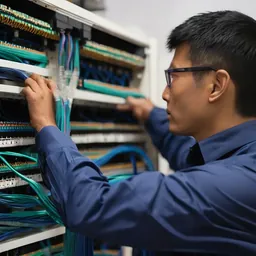 综合布线Cat6/Cat6A 与光纤,两端贴标签,每条链路逐一测试,并移交竣工图纸。布线一次做对,可用 15 年以上。
 企业局域网与交换核心–接入架构的局域网,划分 VLAN,上联冗余,PoE 供电充足。一根插错形成环路的网线,再也不会让整栋楼断网。
 企业 Wi-FiWi-Fi 6/6E/7,AP 点位依据实测部署。会议室满员也能用,走动通话不断线,采用 WPA3 加密。
 分支机构 SD-WAN外省分支同时使用两条互联网线路,一条故障另一条数秒内接管,全程加密。
 点对点无线链路数公里 PtP/PtMP 无线链路,跨越道路和河流,连接无法布线的楼宇和站点。
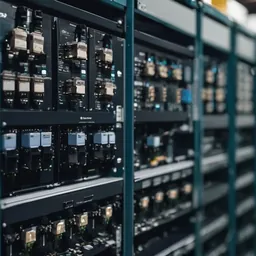 工业网络 (OT)耐粉尘、高温和振动的工业交换机,环网冗余、IT/OT 隔离,适用于工厂和矿山。
发给我们建筑平面图或几张现场照片
我们会先询问一些细节,再给出初步设计方案。首次咨询免费,可用老挝语、泰语或英语,通过 WhatsApp 或 Facebook 主页联系。